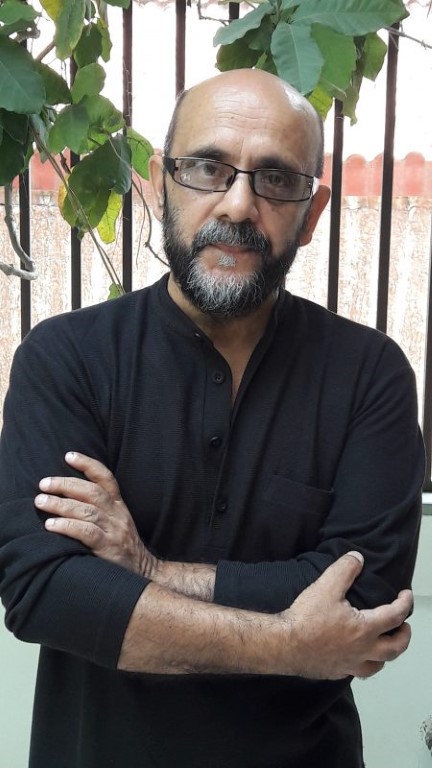
Asim Waqif, an Indian artist, traverses architecture, ecology, and the vibrant life of cities to create art, representing India at the 2026 Venice Biennale. Waqif, born in Hyderabad (1978), trained as an architect, has become an artist and created a vocabulary of alluring atmospheres, sculpture, installation, and video. Through artwork, Asim Waqif examines how materials, locations, and systems operate within intricate social and ecological networks. It is grounded in experiences of the urban fabric and of exceptionally marginal or abandoned sites that bear the scars of forgotten communities.
Asim Waqif expands his lifelong explorations of vernacular water, waste, and architectural resilience systems and emphasises impermanence by employing frangible, transient, or purposely decaying materials, presenting this as a political and ethical stance. He places his projects in the public sphere, in discussions, focusing on sustainability and the future of urban living, making his contribution both relevant and urgent.
Biography of the Artist
After completing his studies in architecture, he began his career as an art director for television and movies. Before entering a specialised art profession, he began producing independent documentaries and videos. His ‘art efforts‘ have taken place in the city’s abandoned and decaying buildings, which serve as covert gathering places for underprivileged communities.
His solo exhibitions at the Islamic Arts Biennial in Jeddah, Saudi Arabia (2025), the Chicago Cultural Center for the Chicago Architecture Biennial 5 (2023), the Hayward Gallery in Southbank Centre, London (Bagri Foundation Commission, 2023), Mattress Factory in Pittsburgh (2023), the Vancouver Art Gallery Offsite (2017), the Palais de Tokyo in Paris (2012), and the Dr. Bhau Daji Lad Museum in Mumbai (2012) are just a few examples of international projects. He has taken part in important events like the Kochi-Muziris Biennale, and residencies at the Skowhegan School of Painting and Sculpture and the Bellagio Centre of the Rockefeller Foundation have encouraged his work.
Art of Asim Waqif
After studying architecture, Asim Waqif later worked as a television art director and an independent director before finally moving into art. In 2005, during his residency at Khoj, he created ‘b a a n s,’ which can be said to mark the beginning of his signature style, combining ‘bamboo, rope, and mango-wood.’ Following that, his work, ‘Agrasen ki bavdi yahan hai! (2008), a site-specific installation, exhibited as part of the festival 48C, Public-Art-Ecology in Delhi. The Hindi word “bavdi” means “well”: a step-well, India’s traditional water-harvesting systems, and a heritage that, for many centuries, provided the country’s only supply of clean water. Beyond serves water, a bavdi, is also a vital community hub for the surrounding neighbourhood. Artists suppose that the Aggarwal community constructed Agrasen ki Bavdi before the Lodis in the 15th century.
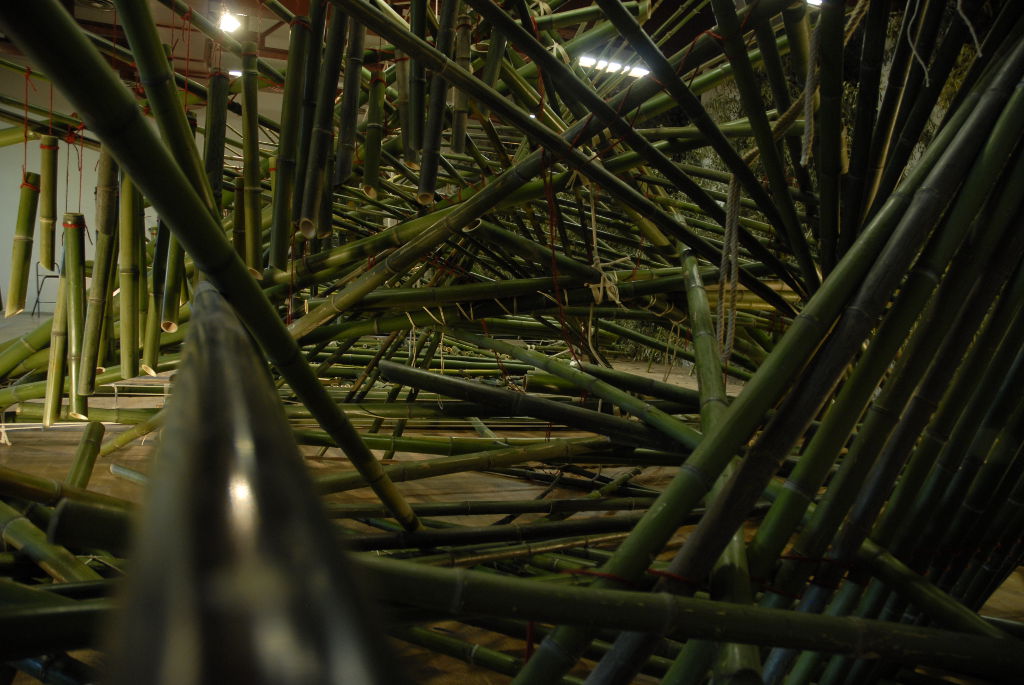
Water sources modernised and ‘bavdis’ were left as abandoned heritage. Artist transforms a Bavdi, which was once part of people’s daily lives and a link that tied the community together, into a gateway to the past that reminds us of its presence. We can integrate it into the present day, into narratives, and into our lives. This work is interposed in an existing structure, a heritage. It becomes a work of art through the artist’s arguments.
In 2009, Asim Waqif presented a visual prologue to the Pandal exhibition in Kolkata, featuring bamboo, rope, and clay sculpture. Curator Heidi Fichtner observed, ‘almost talisman-like, through the meticulous application of lustrous finishing elements’, and phrased the exhibited projects as ‘meticulous attention to materials and uncommon aesthetic elegance over time.’
Asim Waqif’s attention to the symbolic and utilitarian potential of his constructions, which reverberate with a rare aesthetic refinement, is evident, and an enormous, site-specific sculpture made of bamboo and rope that honours the transient ceremonial building and its essential function in the Pujas’ delighted crowd. A clay statue of Saraswati adorns this piece, which features a helioflex apparatus that doubles as a wall sculpture and is assembled from metal, wood, and architectural plans. Here, the artist aims to highlight the formal beauty and cultural significance of simple handmade instruments while expanding upon conventional processes and basic materials.
Cities in Ruins, Systems in Flux
The artist’s final project of a 3-month residency in Milan, Italy, in 2010, problematises the idea of ‘consumption’ and is woven with ‘exhaustion’. Society, its consumption, and the way they are exhausted are the core of this project. An artist criticising the way Society is constructed and maintained by consumption, and implying ‘exhaustion’, which is the outcome of this cycle. People are usually referred to as consumers, a term rooted in capitalism. Artist embassies, this is a drastic shift from earlier craft-based societies, where concepts of thrift and sustainability were inherent. Artists argue for a return to ancestral knowledge, which achieved a balance between needs and available resources, rather than relying on new technology to solve problems.
Today’s solution to a problem may become tomorrow’s problem. There isn’t any ultimate solution or problem; that is entwined in a circle of fluidity. When we try to develop newer technologies to solve these problems, we create more complicated issues for the future. What can an artist do in this consumeristic Society? Artists can give insight into today’s issues and guide people, at least give advice, which is, as he stated, through this work. This work is a response to the market economy and to the political use of ‘new technology’. In a profit-oriented economy, as argued by the artist, short-term solutions are the only possibility. Artists emphasise that solutions developed by a craft-based society are real problem-solvers.
The artist shared the concern that the cycle of consumption is heavily in favour of industry, and that industry has worked hard over the last few decades to create products that last only a limited time. The artist is pointing to the political system that professes to work for the people, but is actually driven by industry’s interests. This collaboration among industry, politics, and media has created unity in innovation and evolution.
Political leaders, parties, media, and the popular spaces they hold power in create and maintain the popular imagination, memory, activities, and choices. As the artist said, ‘that politics, media and industry are mixed up and they are all aiding each other’. This work of art does not merely recreate its time; it problematises it. Through art, life itself is being scrutinised, and the artist argues that, by becoming a way of life, capitalism provides only temporary solutions to problems. The artist himself says there is nothing new in what he is saying. It is only trying to show the context which art has influenced. He is not trying to persuade someone to live differently. Nor is his project about the evils of modern Society, he says. It is only about giving a hint that another life is possible, creating an alternative portrayal for other possible lives.
Between Decay and Possibility
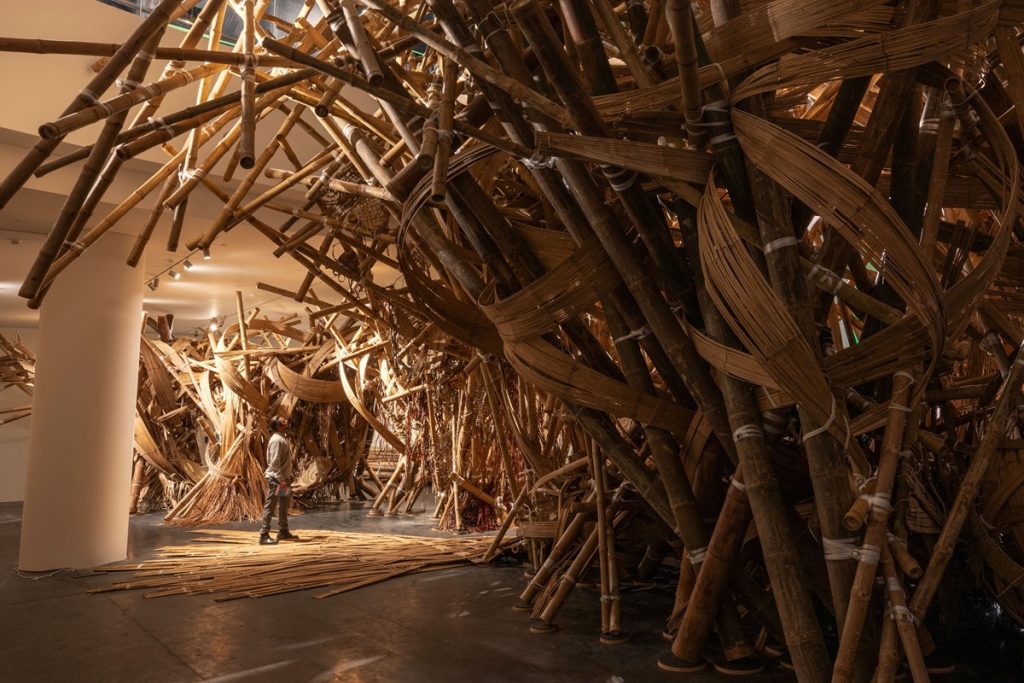
An interactive electronic and acoustic system is integrated into the 2024 site-specific project, Chaal, for NMACC Mumbai, which uses bamboo, cane, screwpine weaving, reed weaving, and various ropes and cables. This work is a reflection of a research trip to Barpeta (Assam), where the artist witnessed the frenzied construction of brick-and-concrete houses and was struck by the heat, with 2 tiny opaque windows. Outside, the older home, made of Ikra and bamboo with a thatch roof, was airy and cool but in disrepair. In the kitchen, almost all the utensils are made of metal or plastic. None of those is produced locally. Traditional use of bamboo in utensils, baskets, Ikra, and construction is disappearing under the pressure of developmental aspirations and the lure of participation in the market economy.
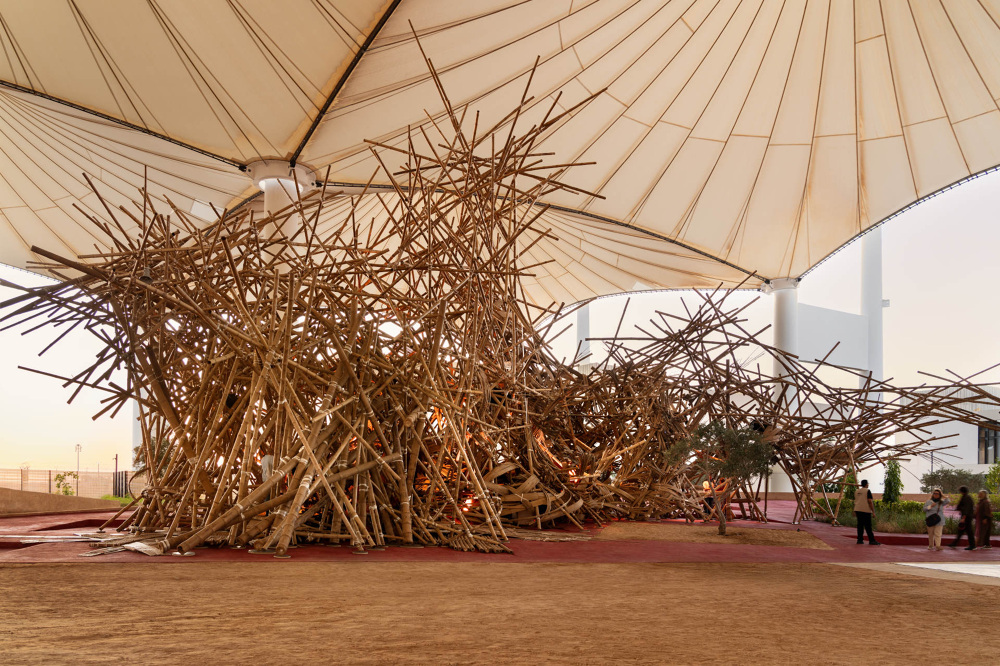
Bamboo, palm fronds, corded strap, interactive electronic and acoustic system. Credit: asimwaqif.com
Ironically, the discourse around sustainability today promotes concepts such as closed-loop systems, local renewable resources, and a low-energy footprint. In the artist’s view, these concepts are integral to almost every pre-industrial Society. Artists propose that traditional knowledge is based on many generations of trial and error, sensitive to local context, ecology, geology, and climate; however, the practice itself can get bogged down by repetition and ritual. New technologies provide us with tremendous resources, but they produce many unwanted by-products that undermine the advantages they create. The artist says he believes that one can develop much more sensitive systems in the future if we view vernacular and new technologies as complementary mechanisms that can work in tandem and even help offset each other’s shortfalls.
In this work as well, the artist expresses his emotional connection to traditional craft and his longstanding disagreement with the lifestyle shaped by capitalist Society. The creations of each era can be seen as responses to the needs of that era. Ideas such as only bamboo being natural and everything else being ‘unnatural’ may stem from an inadequate understanding of this era, its needs, and its ways of formation. However, it is indisputable that sustainability is not merely a slogan.
The artist’s frequent topic of discussion is the return to nature, a theme he has explored over two decades of artistic endeavours. It concerns the extent to which our constructed environment deviates from the natural world. It concerns the potential for creations that maintain a connection to the natural world. It is about the choices that drive nature to advance. His creation, Venu, in 2023, is a new version of Improvise, a site-specific installation for the Kochi Muziris Biennale. It is a “contradiction” between the organic bamboo structure and the concrete setting. As the artist says, ‘I want to create a situation where one can be liberated from the burden of formal appreciation of art’. The distinctive features of Waqif’s work—such as the use of natural materials, a hands-on, fluid construction process, accessible visitor contact, and an interest in weaving, basketry, and vernacular architecture—combine to form a societal critique, transforming them into large-scale, seemingly chaotic assemblages.
The artist described the installation done in Chicago as a ‘beautiful pile of mess.’ That creation, made using found materials, is a response to impermanence and temporality. ‘We’ ourselves, our own lives, become the subject here. It is a critique of that, responding to lives made possible through space with life itself, questioning it.
Asim Waqif powerfully reminds us of art’s ability to address the pressing issues of our day. Waqif creates striking critiques of consumption, sustainability, and the structures that shape modern life through discarded buildings, brittle materials, and makeshift structures. His projects, which draw on ecology, craft, and firsthand urban experience, do not offer simple answers or definitive fixes; they create opportunities for introspection, ambiguity, and other approaches. Waqif’s art emphasises awareness, ethical creation, and the importance of rethinking how we live in our surroundings in a world characterised by fast change and environmental stress.
Feature image: Chaal (2024) site-specific installation for NMACC Mumbai- Bamboo, cane, screwpine weaving, reed weaving and various ropes and cords; embedded with an interactive electronic and acoustic system. image credit: Artist
Krispin Joseph PX, a poet and journalist, completed an MFA in art history and visual studies at the University of Hyderabad and an MA in sociology and cultural anthropology from the Central European University, Vienna.