War continues to play a significant part in political, historical, artistic, and cultural narratives in a world where conflict frequently changes civilisation. Unexpected attacks and conflicts in the Middle East are examples of ongoing geopolitical issues that serve as a reminder that war is not merely a distant historical event but rather a permanent reality that changes civilisations, geography, memory, and identities. Beyond the battlefield, war had a lasting impact on memory, art, and society.
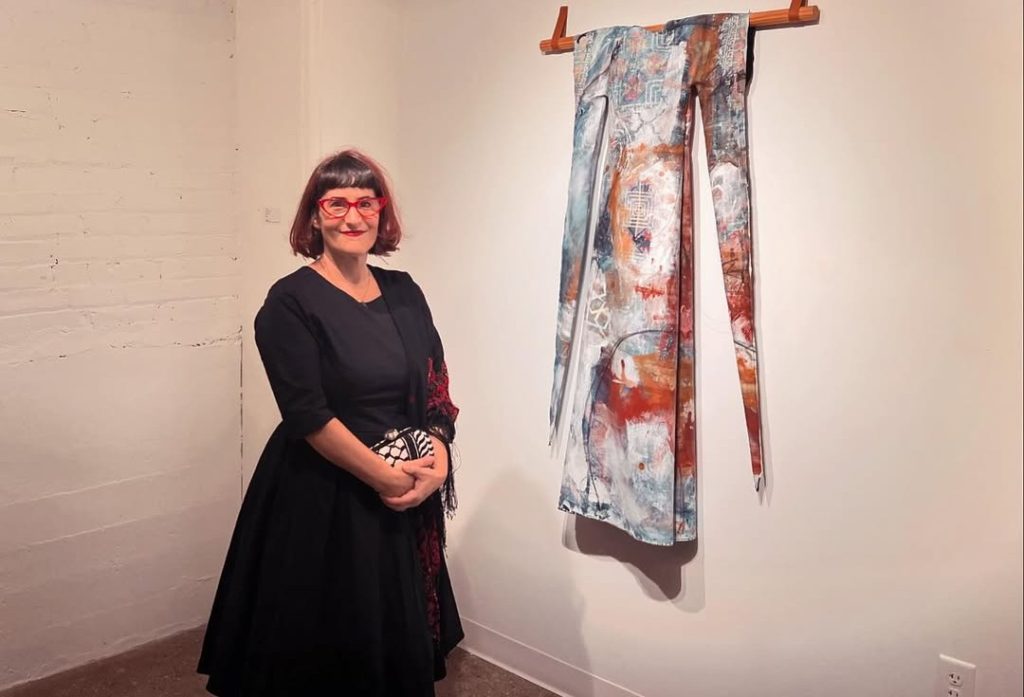
Against the backdrop of ongoing wars, an interview with the artist Samar Hussaini, who lives in America as a ‘Palestinian refugee’, as a victim of war. The artist talks about her artistic life, art environments, and politics.
As part of Abirpothi’s interview series, artist Samar Hussaini discusses her artistic life and her art.
Q: Your work often engages with themes of displacement, memory, and identity. How has your personal background as a Palestinian-American shaped your artistic practice?
Samar Hussaini: I’ve always been proud to be Palestinian American. I was raised within a culture rooted in strength, generosity, and deep connection to family and land. Even in the diaspora, Palestine lives through us in stories, traditions, and daily life. That sense of belonging, even when physically distant, shapes how I think about memory and layering in my work. My practice becomes a way of holding onto a culture that persists despite ongoing attempts to erase it, and it naturally becomes part of my work, shaping how I think about memory, layering, and belonging.
Q: Many artists respond to conflict indirectly rather than depicting violence itself. How do you translate the emotional and historical consequences of war into visual language in your work?
Samar Hussaini: I focus on the emotional weight, things torn apart, and slowly coming back together. My abstract work allows me to express this through colour, marks, and layers, creating a visual language for the emotional impact of war, destruction, and pain. My work reflects fragmentation and rebuilding, and through it all, there is still strength and resilience. That sense of endurance carries through the layers of my work and reflects a connection to land and culture that continues, even in the face of loss. Palestinian identity is not defined by destruction, but by its ability to endure, adapt, and persist. That quiet strength is what carries through my work.
Q: Your art frequently explores the experience of diaspora. How do you negotiate the relationship between memory, inherited stories, and lived experience in your practice?
Samar Hussaini: For me, it is always a balance. I’m working with memories I have lived, but also with stories passed down to me from my family. These memories, even if inherited, feel present and urgent. In my work, I try to hold all of that at once. I want the viewer to feel that layered experience, something that is not just mine but shared by many people with a diasporic background. My work holds that collective experience, one that is shared across generations, where identity is carried, protected, and reimagined.
Q: The thob appears as a recurring motif in your work. What first drew you to reinterpret this traditional garment within a contemporary mixed-media artistic framework?
Samar Hussaini: The thob drew me in because it holds the presence of Palestinian women across generations. It carries identity, region, and narratives through embroidery. It is not just a garment; it is a form of resilience and continuity. Reinterpreting it allows me to honour that legacy while also rethinking how it can exist today in a new, expressive form rooted in my narrative and regional identity.
Q: In many Palestinian communities, the thob carries regional, social, and historical meaning. How do you approach this cultural symbolism when transforming it into an artistic form?
Samar Hussaini: I think about the thob as both historical and personal. It connects to regions, traditions, and narratives, but in my work, it also reflects my own experience as a Palestinian American. It becomes a way for me to hold onto my culture and pass it on. At the same time, I reinterpret the dress, allowing it to change and grow so it can speak to an ever-changing experience in different ways. When I think about the history of these embroidered dresses and how they have evolved stylistically and across regions, I see my sculptural thobe dresses as a natural and continuous process.
Q: You often combine materials such as acrylic paint, ink, collage, charcoal, and gold leaf. How do these layered materials help convey themes of memory, resilience, and identity?
Samar Hussaini: The materials I use help me express a feeling over time. I do not see them as separate; they all work together. I layer paint, ink, and other materials to create surfaces that feel like memory. Some parts are clear, others are hidden, and some are changed again and again. This process reflects how identity is formed. It is not fixed; it is built over time.
Q: Your works, such as Legacy, Rise Up, and Welcome All Exiles, revisit histories of displacement and resistance. How do you see these pieces contributing to conversations about Palestinian history and memory?
Samar Hussaini: These pieces come from my own experiences grounded in Palestine and what I have learned from my family’s history and experience, but they are also meant to reach beyond that. I want people to connect to the work in their own way; contribute to a larger conversation about people who continue to exist, create, and remember despite displacement. Through abstraction, I am not telling one story; I am creating space for many stories. It opens up a conversation about displacement, resilience, and what it means to carry history with you, while holding space for the Palestinian narratives that are often overlooked.
Q: You have described art as a catalyst for dialogue and empathy. What kinds of conversations do you hope your work initiates among audiences from different cultural backgrounds?
Samar Hussaini: I want my work to feel open and welcoming, creating a quiet space for people to connect on a human level. I am not trying to tell people what to think. I want them to come in, spend time with the work, and see what it brings up for them. If it creates even a small moment of connection or understanding, that means a lot to me.
Q: Many of your works reinterpret traditional embroidery and tatreez motifs. How do these patterns function as visual archives of Palestinian history?
Samar Hussaini: Tatreez is very important to me because it comes from women who passed it down through generations. Each pattern holds meaning and connects to place and identity. When I use these patterns, I am thinking about all the hands that came before me. It is a way of honouring them. These designs are not just decoration; they are a way of keeping history and culture alive through making.
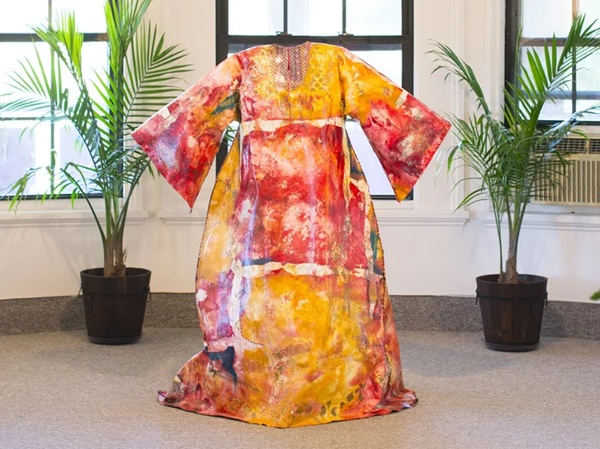
Q: The thob in your sculptures and paintings often appears as an empty garment rather than a worn one. What role does absence or invisibility play in communicating ideas of loss and displacement?
Samar Hussaini: The body is not there, but it is still felt, and that is very important to me. The empty thob carries a presence even without a figure inside it. It speaks to loss, but also to memory and strength. I think of these forms as holding generations of women, grandmothers, mothers, daughters, whose stories are still with us. They may not be visible, but they are still here at work. It also raises a question for me about what happens to culture and heritage after war and destruction, and what continues to be carried forward.
Q: Your work draws from stories of exile and the experiences of earlier generations, particularly those affected by the events of 1948. How do family narratives influence your artistic process?
Samar Hussaini: My family’s experiences have deeply shaped how I think about my work and how I create. Their stories are not separate; they are part of a much larger Palestinian story of displacement and endurance. I carry that with me in my process. It is not just about telling what happened, but about honouring the strength and resilience that continues across generations. I think about how these stories are held, remembered, and passed on, and how my work can be a space where that continuity lives.
Q: In your practice, tradition and contemporary artistic techniques are closely intertwined. How do you balance preserving cultural heritage with creating new artistic interpretations?
Samar Hussaini: For me, tradition and contemporary artistic techniques are always in conversation. Tatreez has been a way of carrying culture forward for generations, through time, care, and the hands that make it. When I bring it into my work, I continue that process in a way that reflects my own experience. I’m not trying to preserve it as something fixed, but to keep it alive and moving. By working with it through new materials and forms, it becomes something that still holds its history while also speaking to the present.
Q: Many viewers interpret your work as both deeply personal and strongly political. How do you see the relationship between art, identity, and political expression?
Samar Hussaini: It’s hard to separate identity from politics when you are Palestinian, and when your lived experience is shaped by it. I don’t approach my work with the intention of making something political, but I understand that it can be seen that way. For me, the starting point is always personal. It comes from memory, family, and lived experience. I focus on emotion and shared human connection, because that feels like the most honest place to begin. If the work opens up larger conversations, that happens naturally through that lens.
Q: In the context of ongoing conflicts around the world today, what role do you believe art can play in shaping public understanding of war and its human consequences?
Samar Hussaini: Art has a way of slowing people down and creating space to see beyond headlines. It creates space to sit with something, to feel it, and to reflect without being told what to think. In the Palestinian context, that kind of space is really important. It allows people to connect on a human level, beyond headlines or distance. I think art can open people up to seeing another perspective, or simply to feeling something they may not have understood before. That quiet shift can be powerful.
Q: Looking forward, how do you envision the future of your work in continuing to explore themes of diaspora, resilience, and cultural memory?
Samar Hussaini: I see my work continuing to grow and expand, both in scale and in form. I’m interested in exploring new materials and possibly moving into more immersive or sculptural directions. At the same time, the core of the work will stay the same. It will always come back to memory, resilience, and cultural continuity. I want to keep finding new ways to carry those ideas forward, while staying connected to my Palestinian roots.
Krispin Joseph PX, a poet and journalist, completed an MFA in art history and visual studies at the University of Hyderabad and an MA in sociology and cultural anthropology from the Central European University, Vienna.