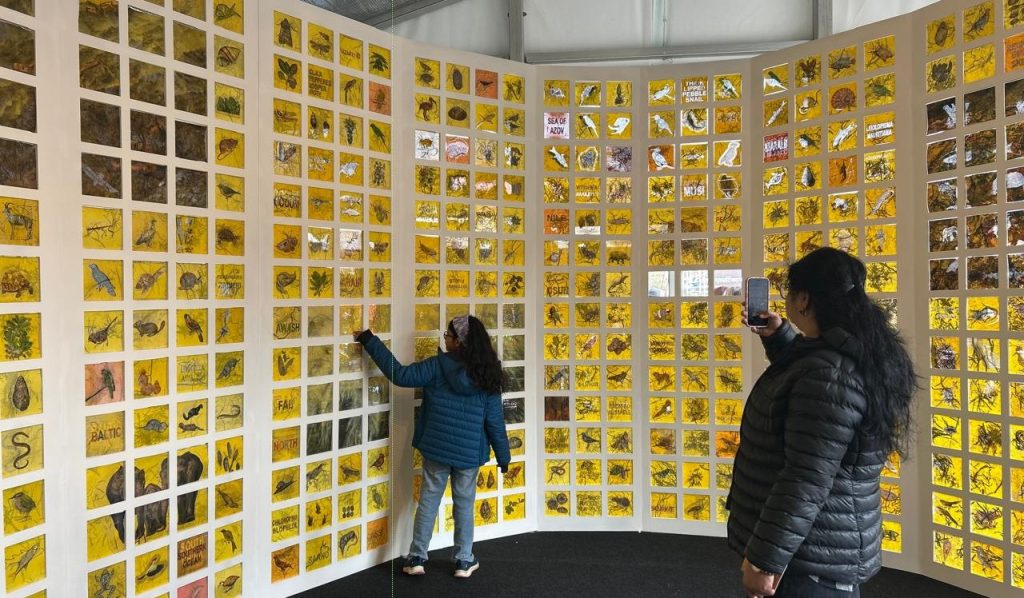
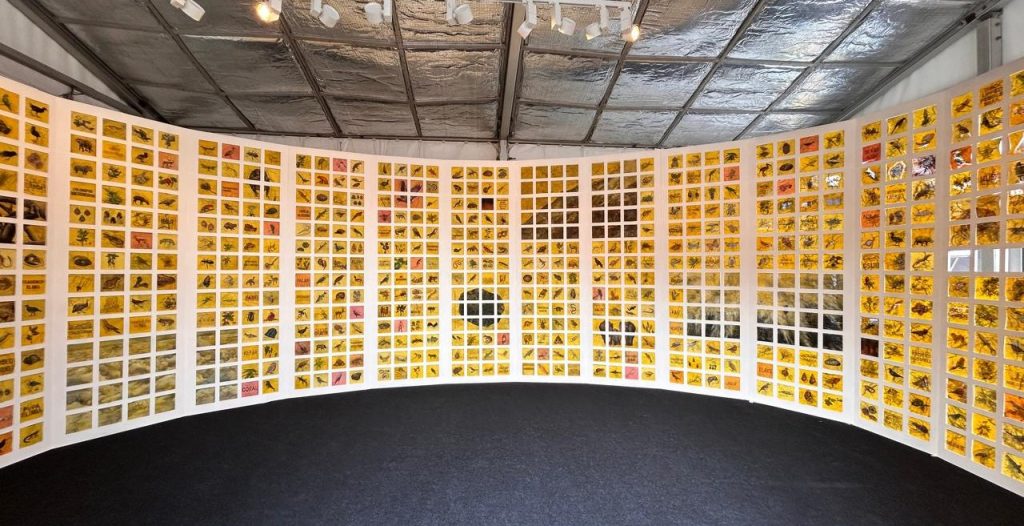
The Extinction Archive project by artist Kulpreet Singh, produced by KNMA on the view of India Art Fair 2026, depicts animals and plants at peril and spans over 900 endangered species, painted on pesticide-dipped rice paper, making the magnitude and accumulation of what is vanishing clear. This show has attracted the attention of art lovers amid concerns that humans may also become extinct. It is worth noting that what is conveyed silently, yet artistically, is the contemporaneity of fear.

In the video featured by KNMA, artist Kulpreet Singh introduces his art creation ‘Extinction Archive’ by saying, ‘When I was a child, I used to see vultures. Suddenly, they disappeared.’ It’s not just birds and animals that have disappeared from our surroundings. Rivers, trees, and plants are all part of that list. It is worth noting that what is conveyed silently, yet artistically, is the contemporaneity of fear. It consists of square panels with rice paper, laser dots, and stubble burning ash that represent the innumerable deaths of all animals, including humans. “When we consider it, Extinction is simply a word. However, these are memories that no longer exist. “It is not just an archive of extinct species; it is an archive of how we are still ruining things for everyone”, Singh told PTI. Curated by Srinivas Aditya Mopidevi, this exhibition is on display at the India Art Fair’s outdoor section. The 40-year-old artist claims that the land, rivers, wildlife, and other aspects of nature are gradually disappearing.
Singh’s panels feature several endangered and extinct species drawn from the International Union for Conservation of Nature’s Red List of Threatened Species. These include the harvestman species Hirstienus nanus, the white blotched shrub frog, the land snail Carelia mirabilis, the Mauritian giant skink, and the angled flat top snail.
Art and Extinction
Extinction is a frightening concept nowadays. In an era of climate change, a time when environmental exploitation has become the ‘new normal’, Extinction is something that instils fear, and it should be understood as a cultural trauma—that is, species, rivers, animals disappear, but their traces linger as haunting reminders. In the book The Mind in the Cave, South African archaeologist David Lewis-Williams mentions that when examining cave art, one can also see narratives of Extinction. Later, many animals that had disappeared have appeared in the cave paintings. Extinction is imprinted in the art of ancient worlds; for example, species such as the cave bear and the woolly mammoth, which appear in parietal art, are now extinct.
Art (whether writing, painting, or sculpture) is a document of one era meant for another, in the sense that it marks a particular time. Over time, it can turn into something like an extinction diary. Many creatures that once lived but later disappeared, including dinosaurs, have returned to popular imagination. Movies like Jurassic Park celebrate the return of creatures that have vanished from the Earth.
Here is a quote from W.J.T. Mitchell in the book ‘Animals, Plants, and Afterimages: The Art and Science of Representing Extinction’: ‘Hundreds of species are disappearing from the planet every day, and it is no longer possible to deny that human beings may be the first species in the cosmos to bring on its own extinction.’
Mitchell points out that two things are essential, and this is an issue that requires urgent attention. Many animals, just like humans, die every day. Just as many human deaths could have been prevented if we had paid attention, the deaths of many animals and birds are similar. But Extinction is beyond daily deaths. It is destruction, an irreversible journey. We cannot simply witness a river, a bird, plants, or species disappear forever. Such a great disaster is here, along with many wonders that we experience.
Following the above statement, the Mitchell Extinction Archive project (not this exhibition) is explained in detail and also criticised. The project can bring something into a new environment (an exhibition!). In other words, it is not about getting the creature into its life, but instead turning it into exhibition material. While the awareness that arises through this is essential, Mitchell says, ‘It is a rescue operation only of images.’ At the same time, this serves both as a critique and as an inquiry into ‘what is an exhibition.’ In Extinction Archive, as Mitchell says, ‘there is no attempt to put them back into their world, into the habitat that made them possible’. Beyond that, ‘it is a melancholy reminder that the living creatures represented are vanishing or have vanished.’
Mitchell’s argument that ‘images can never become extinct’ is relevant. By adding phrases like ‘they may disappear, be buried, or destroyed,’ it conveys that the existence, continuity, and survival capacity of a created image are beyond art and prediction, enduring over time. The extinction archive is often conceived as traumatic, both individually and collectively. Representations—whether in art, literature, or museum displays—become ways of processing that trauma.
Friedrich Nietzsche says, ‘If you kill a cockroach, you are a hero; if you kill a butterfly, you are evil. Morals have aesthetic criteria.’ We often witness Extinction in systems that divide us into categories. Extinction can happen at either boundary of these categories. It’s not just the butterfly that can become extinct; a cockroach could be wiped out from the group as well. Categorisation is like giving someone a license to treat ‘one’ however they want. If a category disappears, the only consequence is that the hierarchical order that included it will change, but nothing else happens.
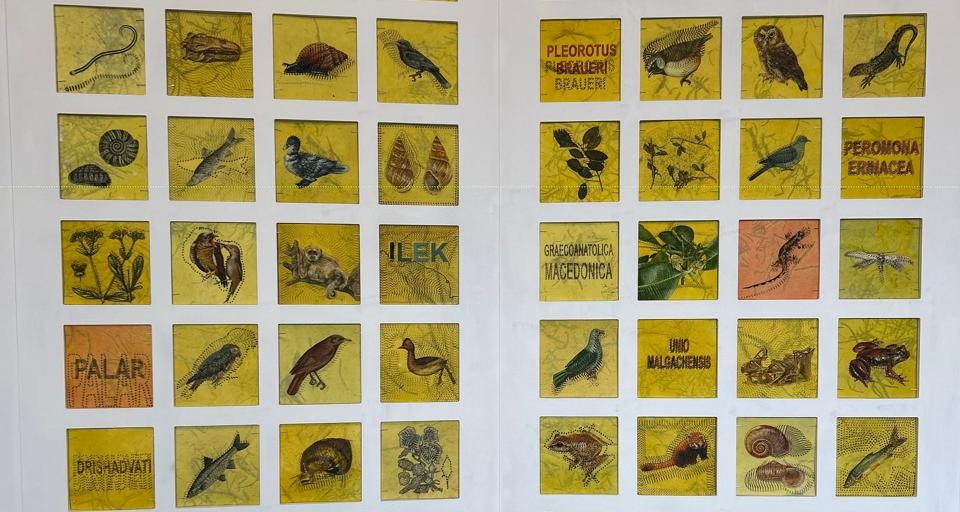
This is where some arguments in Anne-Sophie Miclo’s article ‘Three Variations on the Theme of Extinction’ become relevant. In the exhibition, Miclo categorises ‘Extinction’ into three categories: ‘extinct species, critically endangered species, and species (including humans) that might be held responsible for a given extinction’. It can be seen that Kulpreet Singh’s exhibition represents these three categories. Humans accountable for Extinction are not depicted in this exhibition. The task of this exhibition is that each viewer should consider themselves responsible for it. In this artwork, the artist is holding up a mirror to his own time. What is reflected in it are his own image and the images of the people living in the same era. This work does not allow viewers, whether they see it or not, to remain indifferent to the responsibilities of Extinction. The actions of our times are so deeply embedded in this creation.
It cannot be said that humans are responsible for all kinds of Extinction. Natural extinctions also occur, as evidenced by the depictions of animals in cave art that indicate past extinctions. However, many of the extinctions reflected in Kulpreet Singh’s artworks are artificial and result from humans being at the centre. The term ‘anthropocentric’ does not merely mean placing humans at the centre of everything; rather, it signifies establishing dominance. This is where Heidegger’s idea of ‘being in the world’ becomes relevant. In other words, issues such as Extinction can be approached in this way. This perspective can address the topic by embodying the idea that humans are not the centre of the world but, at some point, just one among many living beings.
The artist states without a trace of doubt that Extinction is a grave issue and requires special attention. The fact is that the Earth’s surface has turned into an area of human-caused destruction. When some species disappear from the food chain, unexpected changes occur. Here, these are representations, representations of absence.
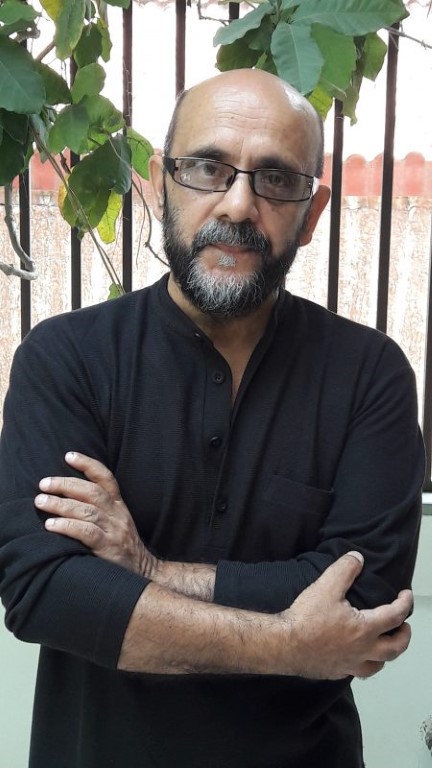
Krispin Joseph PX, a poet and journalist, completed an MFA in art history and visual studies at the University of Hyderabad and an MA in sociology and cultural anthropology from the Central European University, Vienna.