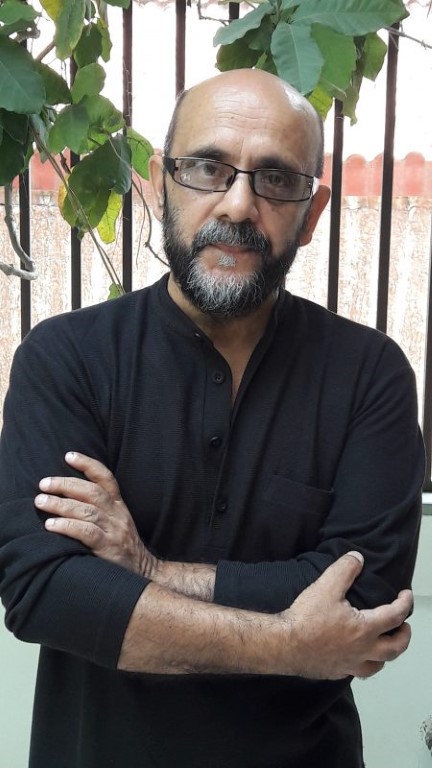
The creative world of Alwar Balasubramaniam, known as “Bala,” spans decades of exciting practice. His techniques, which began with an intense focus on painting and printmaking, evolved dramatically after 2000, when he turned toward sculpture and immersive installations—an ongoing exploration now culminating in his role as India’s representative at the upcoming Venice Biennale.
As we know, materiality is at the centre of artists’ worlds of inquiry. Artistic quests occur precisely in what can be carried out through materials. Concepts, their atmospheres, and the partly elusive nature of materials come together to nurture, as Alwar Balasubramaniam proposed in his works. If art has always been a continuation of a person’s introspection, then, as Francis Bacon said, ‘the job of the artist is always to deepen the mystery,’ it must also be noted. The ‘mystery’ should be noted; it holds an indispensable place here. A distorted world of grandeur, transformed materials in altered form.
As an artist, Bala’s journey has been through a variety of materials. Lithography and printing in the early years, incorporating sand; later, laser-burnt marks and screen printing on paper; stencils, acrylic, and silicone on canvas; fibreglass, acrylic, and wood; fibreglass and acrylic; terra cotta and cement; iron, sandstone—through his practice, many materials have transformed. Another significant development in the artist’s practice in the 2000s was the incorporation of his own body imprint into his works. That is, the artist began casting his own body and using it to produce works. The artist is not only someone who creates art; his hands and body become part of the artwork itself, becoming art in their own right.
Introspection is one of the most critical aspects of Indian philosophy. It is not something confined only to philosophy. However, ideally, that is how one would put it, a philosophical view of oneself. However, while the human body has a philosophical notion in its depths, it is a material entity, or in Deleuze’s view, an assemblage. Moreover, materially, the perspective presented here is that a person’s body, in its mere, transient state and existence, is a material with enough depth to become a work of art. Whether it is a person’s hand (Untitled, 2002), the body in Self in Progress (2002) as it is, or, as in the works in the ‘Kaayam’ series, the artist subjects his own body, like discarded clothes, to various states and transformations. The point is that, through practice, even hands, legs, the body, its shapes, wrinkles, and folds can be transformed into material capable of becoming art.
Traces and Traces of Oneself
Alwar Balasubramaniam talks about making one’s own body part of the art, saying it is ‘traces’ and ‘signs of a former presence … the sculpture is nothing but a trace of myself.’ The artist tries to discover his own ‘traces’ and preserve them as ‘traces’ through his artworks. From a different perspective, one can see that a person’s body holds unlimited possibilities within.
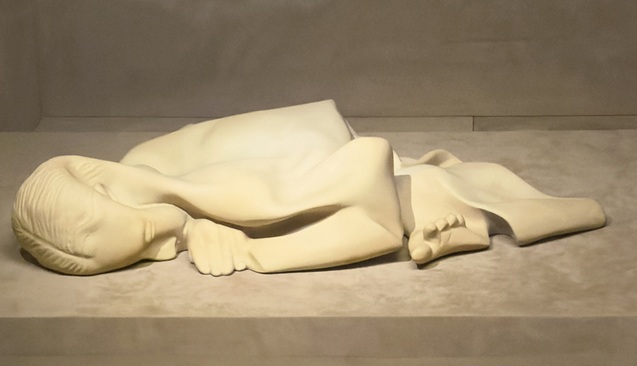
Permanent Collection of The Metropolitan Museum of Art
‘Lines, I insisted, are phenomena in themselves. They are really there, in us and around us,’ says Tim Ingold in his classic book, Lines. When we say that artistic practice and the art it produces are attempts to ‘trace’ oneself, Ingold’s idea in Lines becomes significant. Considering that numerous works by artists have been titled ‘traces,’ the argument gains traces that the artist is essentially pursuing something with a philosophical undercurrent. ‘Yet it takes only a moment’s reflection to recognise that lines are everywhere. As walking, talking and gesticulating creatures, human beings generate lines wherever they go,’ says Ingold. This means that, just like the artist Bala does in his creations, one can clearly understand how ‘he’ follows his own ‘traces’ and shadows of his previous’ signs,’ leaving behind a presence, a work of art.
Through the statement “Everything is one, yet we like to divide – every field, every subject. We’re conditioned to see them as separate, but for me, the self and existence are one,” the artist deeply explores the relationship between the material and individuality. In the thesis submitted by Lotte Betting at Leiden University, detailed observations on Alwar Balasubramaniam’s artworks are presented. The observation that Alwar’s creations should be seen as a ‘synthesis of Western modernist abstraction and Indian spirituality’ is relevant. That is, the essence is that what is incorporated in his creations is neither entirely Western nor Eastern. It can be seen that a multilayered, materially related self-awareness forms a uniquely ‘Indianized’ perceptual world that cannot be separated from spirituality, and a Western-influenced artistic practice shapes this.
The freedom and possibilities offered by Indian spirituality fuel abstract art in India and beyond. That is both a possibility and a trap for artists. By consciously employing certain concepts from Indian philosophy, it is possible to transform one’s artworks into something unquestionable and to shape and establish their abstract form. It cannot be said that the entirety of Alwar Balasubramaniam’s artworks belong to Indian spirituality or Western modernism. Moreover, it may also be a continuation of the artist’s own discovery, abstract reflections in the time being.
The artwork ‘Self in Progress’ feels like entering a wall when viewed from one side. When seen from the other side, it feels like emerging from the wall. The space in between, the middle part, is inside the wall. The artist has hidden in the title an explanation of what ‘Self’ is. In the artwork, the ‘Self’ is at a stage in a process. The wall metaphorically speaks to many things. It could be life examining progress, a passage that carries it forward, or the past of a person who has crossed through it. The wall in an artwork is not just a wall; it can speak metaphorically. One must be careful with metaphors!
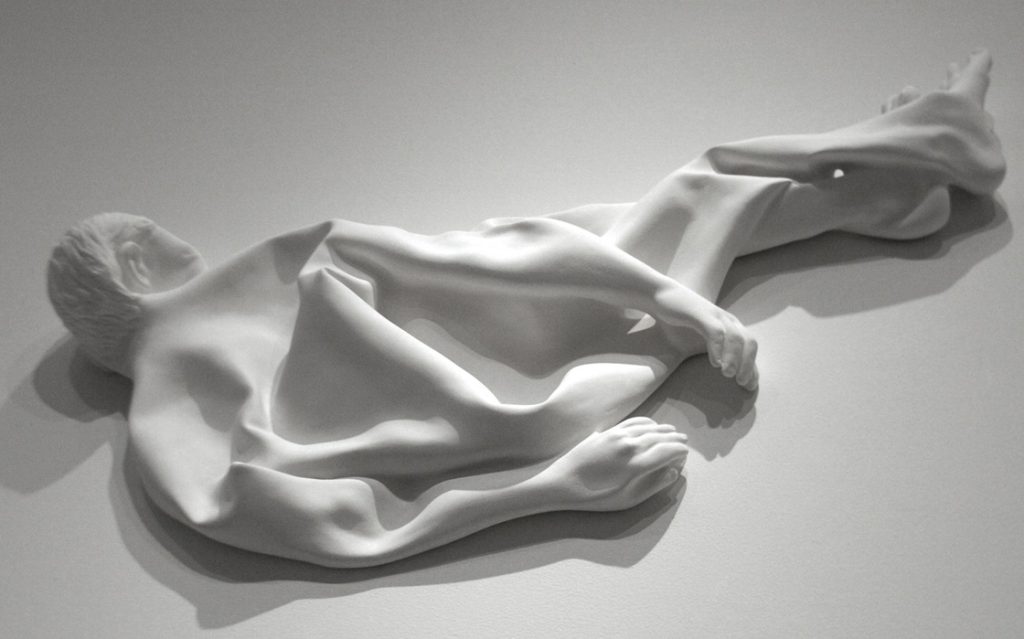
As the self itself becomes a subject of examination again, Body as Shell is a composition that deserves very special attention. This sandstone artwork defies its material, appearing as a pile of human skin thrown on the ground, like a gown. The artist used fibreglass and moulded rubber to recast a plaster version of his own body. This machine-carved, hand-finished variant is the result of additional castings and modifications. It is a fact that ‘I’ is a material reality, greater than any knowledge. It exists as a material among short and eternal notions. However, philosophically, life is as simple as taking off a gown for a moment.
‘Body as Shell’ portrays the artist’s ‘trace of myself’ into an ageless form. That transitioned, deformed self is magnificent; it is a fantasy, an invitation to a conversation, an object for the unreal worlds. The MET note about this work says that ‘the body appears to be withered away, no longer a mass but a mere shell.’ That is, it is a shell, a centre of creation where pearls bloom more than (un)clothing, curiosities.
About this work, Diana Seo Hyung Lee argue, ”the body is deformed, contorted, not grotesque, evoked by a delicate fabric, out of which portions of arms, legs and head emerge. By casting and reshaping the exterior layer of his body, Bala gives greater visibility to what is familiar through its distortion, as if to suggest that the body is not so much ours as we may think. The artist’s body, apart from the artist, takes on a life of its own.’
Bala’s practice reminds us that art is not merely the manipulation of materials but a sustained inquiry into presence, perception, and the mutable boundaries of the self. Across decades, he has used materials —whether sand, silicone, stone, or even the imprint of his own body—to probe what lies between the seen and unseen, the sensed, the formed and the formless. In doing so, he transforms the everyday substance of existence into sites of philosophical reflection, where traces become revelations, and the body becomes both question and answer.
As he steps onto the global stage at the Venice Biennale, Bala’s evolving oeuvre stands as a testament to how mystery, introspection and material experimentation can converge into a singular artistic language—one that continues to deepen, expand, and invite us in.
Krispin Joseph PX, a poet and journalist, completed an MFA in art history and visual studies at the University of Hyderabad and an MA in sociology and cultural anthropology from the Central European University, Vienna.