In Manjot Kaur’s paintings, the lush, liminal world interprets the Indian miniature tradition and seeks novel ways to present it, producing a new lexicon and visual delight. As we know, painting is the art of seeing, and it enlarges and broadens the viewer’s world when engaged with. This is achieved in Kaur’s painting through translating the artist’s feminist-ecological stance into a work that presents mythologised worlds in which birds, trees, lakes, snakes, and forests are reconfigured beyond strictly biological categorisation and are witnessed as living beings.
In Kaur’s canvases, the purpose is a forceful recapture of the body as ‘fabulation’, as Deleuze argues, it gives marginalised voices—both human and non-human—the opportunity to express themselves and regain agency. This creative approach initiates easily interpreted paintings with numerous undercurrents by fusing myth, ecology, and feminine embodiment to imagine new kinds of kinship between species. Instead of recounting ancient myths, it creates new worlds in which animals, birds, and elemental elements communicate through altered bodies. Fabulation becomes a speculative and political weapon that questions prevailing narratives, blurs the lines between fact and fiction, and reimagines reality through feminist and posthumanist viewpoints, and more than just imagination or “make-believe” in the context of Manjot Kaur’s artistic vocation. Instead, they serve as a means of imagining “what if” scenarios that contradict the ecological and gendered reality of today. She creates a new mythology by depicting women whose reproductive systems either blossom into exotic flowers or merge with the anatomy of birds. These are not monsters; rather, they are “fabulated” representations of a culture that regards nature as a peer rather than an exploitable resource. Through the creative process termed Fabulation, Kaur depicts everything in contrast to straight storytelling, creating new worlds, viewpoints, and opportunities to challenge accepted facts rather than depicting the world as it is.
As we know, Indian miniature paintings have long been a field of detailed analysis, and many forms of reading, including feminist readings, have continued to be pursued through active scholarship. From Kaur’s perspective, it is a visual engagement that allows for extensive readings of miniature, and it is described as ‘mythology, botanical surrealism, and eco-feminism’ of ‘Modern mythologies’. Manjot Kaur is creating an alternative, an ‘ecological’ one, to the much-lauded archetype called ‘Mother Nature’ through her paintings, which can also be referred to as ‘visual research papers,’ beyond being paintings. Manjot Kaur uses a surrealist lens as an artist. Similarly, the unapologetic feminist gaze turns those images and the worlds she creates into something that must be ‘read’ beyond just seeing.
When poet William Blake said, ‘I must create my own system or be enslaved by another man’s,’ it is clear that he had a precise vision of having his own ‘system/world.’ However, this ‘personal’ world is a continuation of various layers of the old world and is connected to it at several levels. That’s why, maybe, Deleuze explains that all becomings are minoritarian: one must be grounded in a world to create a new one. In short, nothing entirely new comes into being by starting from scratch; it is more like a new vine growing from the last breath. It is a natural process; otherwise, that is ‘nature’ itself.
In Indian miniature paintings, one can see the reflection of the patriarchal system. In the central position is a man, often a king or someone of equal status, while the rest of the worlds are depicted as those who revere ‘his world’. In that sense, there is no ‘her world’ depicted. When women occupy the central position, we see that they exist only as narratives, such as Abhisarika Nayika. This is where Kaur’s narratives are relevant. As Deleuze stated, it is an enactment and a rereading carried out after establishing a ground in one’s own language or visual culture.
Abhisarika Nayika and beyond
By examining how Kaur interprets the critical area of Indian miniature painting, Abhisarika Nayika, in her own way, we can understand what the artist intends to convey, especially in the painting Hybrid Being 3. The character Abhisarika Nayika is depicted as a woman who leaves her house at night to meet her lover. If the Abhisarika Nayika in miniature paintings is narrated as a girl going out to meet her lover, Kaur questions that narration of ‘Abhisarika-ness’ and converts it into a new narrative, towards a sort of ‘hybrid being’. Instead of the perverse reading of the heroine walking out at night, in Kaur’s creative rereading, Nayika’s face is replaced with that of the bird—more precisely, the critically endangered nocturnal Jerdon’s courser, which is native to Southern India. The artist presents a “nocturnal bird” as the anthropocentric subject in an effort to lessen the weight of the male gaze (and human-centric vision). Considering that the bird depicted by the artist in this painting, Jerdon’s courser, has appeared before humans only very rarely, the depth of ‘reinterpretation’ conveyed through this image becomes evident.
‘Just knowing stuff’ is also a way of living, Timothy Morton notes in his book Being Ecological. Knowing things, subjecting them to rereading, and allowing the protagonist to undergo a kind of possession into a nocturnal bird, opens up a new path of reading. It is a process of rereading some things and coexisting with others. The concept of the Abhisarika Nayika, ‘courtesan heroine,’ is also, in a way, a form of reading. One cannot remove this theme and category from the literature of that time. Interpreting it from the perspective of a new era does not mean completely discarding that period; instead, it involves explaining it at a new level. Indeed, when one rereads the concept of the ‘courtesan heroine’ through a critical lens, it becomes a critical reading in itself.
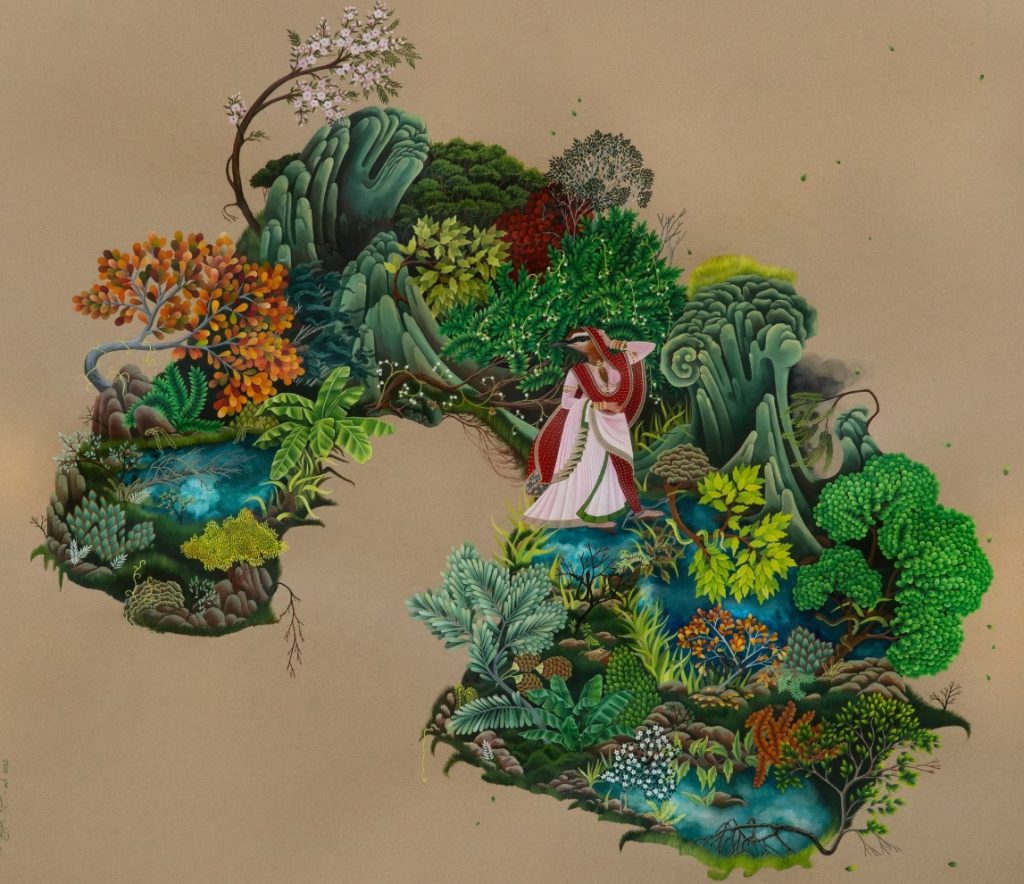
On the canvas, ‘Abhisarika’ is depicted walking through a forest, amid an atmosphere filled with many trees, snakes coiled around them, hills, lakes, flowers, and fragrances. The forest’s ‘Abhisarika’ is a woman imagined as a bird. It is when the forest spreads its fragrance that the artist allows her heroine to engage with her lover. Here we see the forest caressing the heroine and the heroine delighting in its grace. Not only does Kaur reduce the presence of snakes, symbolically representing death, but the change she makes in her ‘interpretation’ also transforms its content, as William de Kooning described: ‘Content is the glimpse of something, an encounter like a flash.’ In this miniature painting, ‘Abhisarika Nayika’ is just a symbol or a link to her own culture. Here, the heroine presents herself like a solo procession in the large theatres of history, which is striking. The heroine’s movement here reminds us that this is something denied to her in history, a movement that revises and rewrites history, and claims’ her own’ space.
Some of Susan Sontag’s arguments, especially in her classic essay Against Interpretation, serve as a tool or perspective for viewing Kaur’s paintings from a particular angle. Art, beginning with the Greek classical arguments of ‘mimesis, imitation of reality,’ and following the Aristotelian arguments of ‘art is a form of therapy,’ reaches Susan Sontag, who states, ‘By interpretation, I mean here a conscious act of the mind which illustrates a certain code, certain “rules” of Interpretation.’ In the case of art, not only in viewing but even in its creation, it is itself an interpretation. These paintings are, in themselves, an interpretation, and for a viewer, they interpret it again; thus, these paintings are shaped by interpretations that unfold across multiple layers. In these works, history, time, contemporaneity, eco-feminism, and ecology are all intertwined, and the resulting complexities make things more ambiguous. Purportedly, Kaur is examining miniature paintings that have lasted for four to five centuries from a specific spatial/temporal perspective. The reflective and investigative aspects within it, the spaces of contradictions, the concept of the Hybrid Being shaped from these contradictions, and the style that articulates it with precision and subtlety elevate these works to their excellence.
Hybrid beings and liberated women’s bodies
Hybrid Beings is a concept that is both promising and challenging, and it is not merely a hybridisation of two states or times, the human-nonhuman dichotomy, or women’s experiences. Although all these elements are evidently present in the formations of these paintings, it is still necessary to philosophically explain what a Hybrid Being is. While it is clear that these works aim to decolonise women’s bodies and the sovereignty of nature, the question remains: how is this achieved? Perhaps, that is the viewer’s mission—not all missions in art belong solely to the artist!
The concept of two components, the relationality and mutuality between bird species (both endangered and extinct) and selected heroines belonging to the Ashta-Nayika, is reiterated as an abstract substance in these paintings. The terms endangered and extinct could indicate differences or similarities among bird species, possibly weaving them together on the same thread of history and ignorance. By combining this element with characters inspired by the staged concept of Ashta Nayika, the artist has created a new category called Hybrid Beings, which extends its wings into many untold anecdotes. This, as the artist herself says, intersects boundaries of speculative fiction, archetypal allegories, and precarious ecologies. That is, each painting is an intersection of many things. In this, the artist undertakes the mission of exploring the historical position of women.
By connecting it to birds that are either endangered or extinct due to human actions or stand on the brink of destruction, the work adds another dimension to the subject. The artist’s effort is not only to free women from the archetypal representations imposed upon them but also to construct agency, including historically denied self-determination, and to speak about its formation. Hybrid, when it combines historical periods, also incorporates tones of contradictions. Releasing the archetypes of the Ashta Nayika from their warp templates is a heroic expression. Whether a woman is endangered or extinct, socially she/they faces suppression across time, which continues even now; in Kaur’s paintings, this reality is mirrored and shattered.
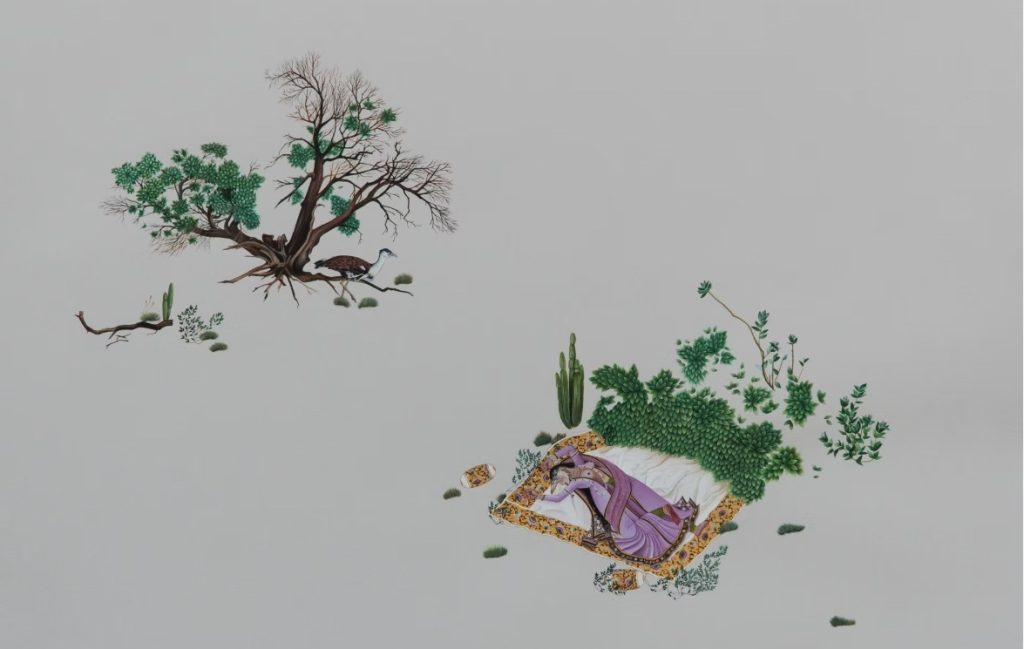
Hybrid Beings should be understood as a political act. These narratives, which combine human and non-human identities while holding out hope for a return, give agency to the marginalised and voiceless (including women and endangered birds). From the edges of destruction and disappearance, the artist opens here a fragrant window of return and survival. The term ‘lines of flight’ coined by Deleuze, to understand the immense possibilities of survival, and the idea it puts forward—that ‘lines always tie back to one another’—can help in understanding the links of the artist’s title ‘Hybrid Beings’ to its history and its issues. As the artist herself says, the conceptual framework of ‘hybrid beings’ fits better within post-queer and post-human becoming, where species move away from questions of identity, recognition, or representation towards an uncanny kind of becoming. ‘Lines of flight’ is the idea through which Deleuze expresses the movement of becoming unbound. The statement ‘line of flight enabling one to blow apart strata, cut roots, and make new connections’ grants a person uncontrolled elasticity of becoming even a Hybrid Being.
What is being done here is contributing a new myth, a myth for the future, to humans who live surrounded by various myths. This myth connects past and future at a specific point and links beings who live with human-made wounds and have become invisible, calling for an evolution into a post-humanistic era. In the human-centred order, recognising that only hell is destined, categorise the struggles and realisations against it under the banner of post-humanistic. If we remove humans from the central position and see Hybrid Beings as a substitute, this is one way to eliminate hierarchy. In a human-centred system, everything is viewed through a profit-oriented lens, which manipulates the life/non-life binary. Questioning it is simultaneously a historical mission and a task that humans themselves must initiate, for an ontological pursuit of what it means to be human, what it means to be non-human, and where these categories rupture and collide.
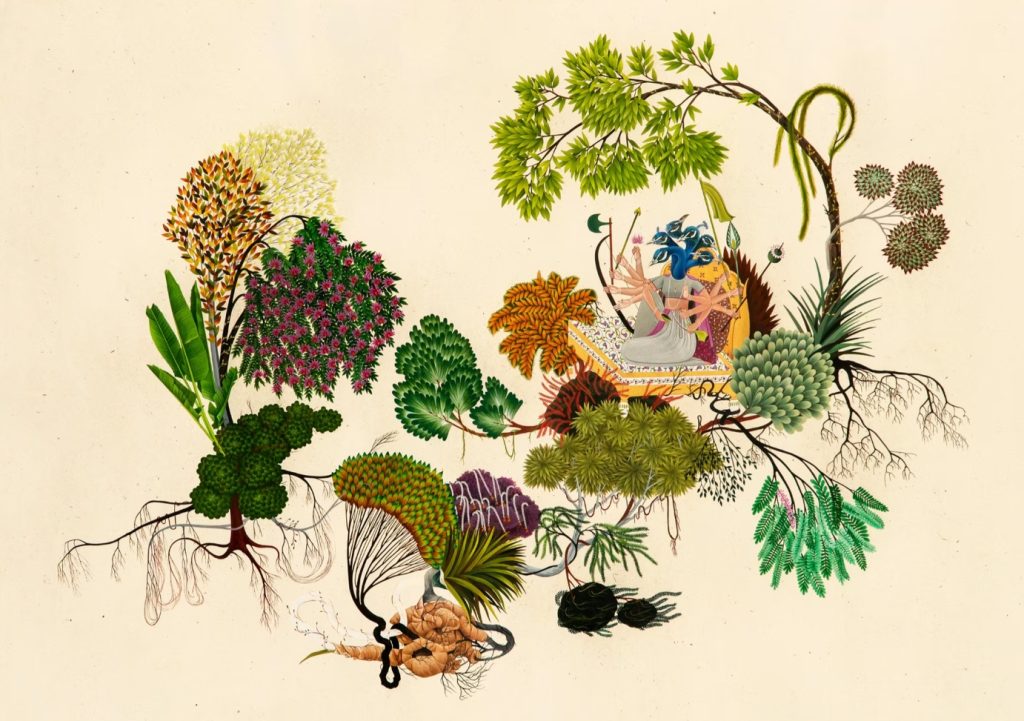
Feature image: Forest invoking Kaumari, Collection Teylers Museum, Netherlands

Contributor