Vivan Sundaram’s artworks exhibited at the Kochi-Muziris Biennale are immense, eerie works that connect his late-career meditations on mortality with his lifetime of political activism. Sundaram’s use of industrial materials to capture the frailty of the human body is best described as a choreography of the transient.
‘Six Stations of a Life Pursued’ is presented as an argument put forward by the artist, a revised and modified version of ‘Stations of the Cross.’ Sundaram strips the work of religious creed, substituting it with a secular, universal voyage of despair and constancy. Instead of rejecting what religion offers, he modifies it, introducing a new motion grounded in the recognition that human survival across time and circumstances is paramount. The ‘six’ indicated in the name is not merely a number; it is a cyclicality, composed of six specific ‘stations’ or orderings. Through this, the artist is creating a link, a hyperlink, to the worlds beyond. It moves from the massing of bodies to their eventual dissolution into the premice audience.
Vivan Sundaram’s final artwork, the photography-based installation ‘Six Stations of a Life Pursued,’ was brought to the Kochi-Muziris Biennale through an invited exhibition. In that sense, this installation serves as a tribute to an artist who has passed away. This artwork was first exhibited at the Sharjah Biennale-15 in 2023. Curated by Okwui Enwezor and titled ‘Thinking Historically in the Present,’ the Biennale featured works by about thirty artists working with parallel thought processes. Vivan Sundaram, among those thirty artists. But he passed away before that exhibition.
Are there any ways to find relief from pain? Are there ways to see and realise the pain that has been relieved? These are all abstract questions and thoughts. Since it is common for whatever is impossible for humans to transform into something beyond the question, let us see what role the above-mentioned matters play in this work of art. Vivan brought many things with thought and practice, and for him, both are like wings that help us lift ourselves out of the pain.
Vivan opens a window with six stations, or six possibilities. This is what people often refer to when they say art is therapeutic. It indicates a journey that pauses not just to find relief from pain, but also to recognise beauty, confront fears, let go of memories, and reclaim life. Each collection of images is different in scale and approach. Continuous practice is required for these releases. Liberation from pain alone will not give you the eyes to see beauty. That is a different practice. Here, journeys to confront fears, let go of memories, and reclaim life are brought together.
Here, we can see an attempt to problematise history or historicity. That is, how can we understand being in history? When we say that this question is primarily pursued here, the very act of taking history backwards also gives history a figurative form, and the contemporaneity that leads us to think historically in the present is also problematised. History is something that is twisted and passes through various narratives, and all one can do is navigate it with the cunning of an activist. This idea is also presented with moral responsibility and a critical perspective. The spelling mistakes that usually occur when history is presented as a narrative are not seen here.
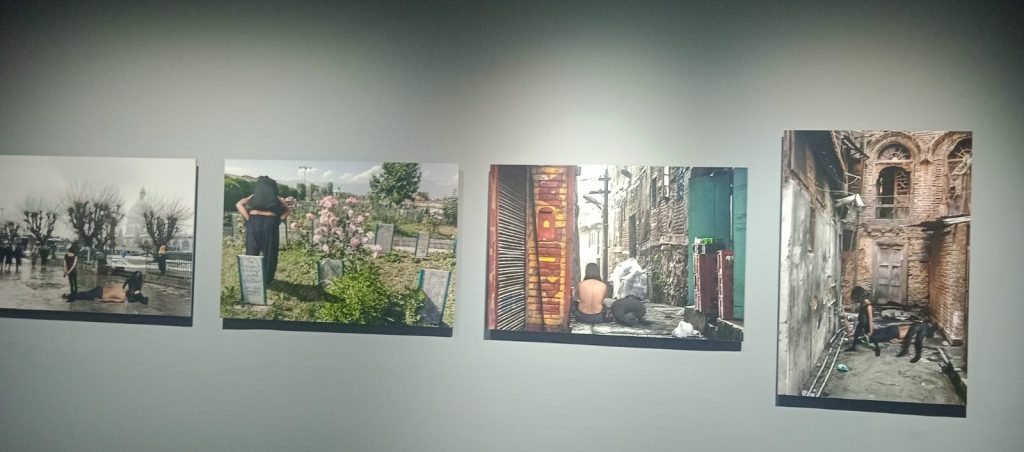
The artist makes this creation experiential through numerous life experiences. Through the presence of bodies marked by the wounds of oppression, through bodies crying out in the realm of shadows, human conditions, along with their historical negations, are brought back to the centre of discussion. ‘Performers in the Vale’ is a photography-based project. The photographs taken during trips to Srinagar are now taking on a new dimension. Each performance takes place in different locations in Srinagar, including the town square, crossroads, lakeside, alleys, highways, and cemeteries. Like locally recruited actors, they themselves become performers in the vale, and they act as wayfarers, an exiled family, giving a glimpse of girlish make-believe and mischief.
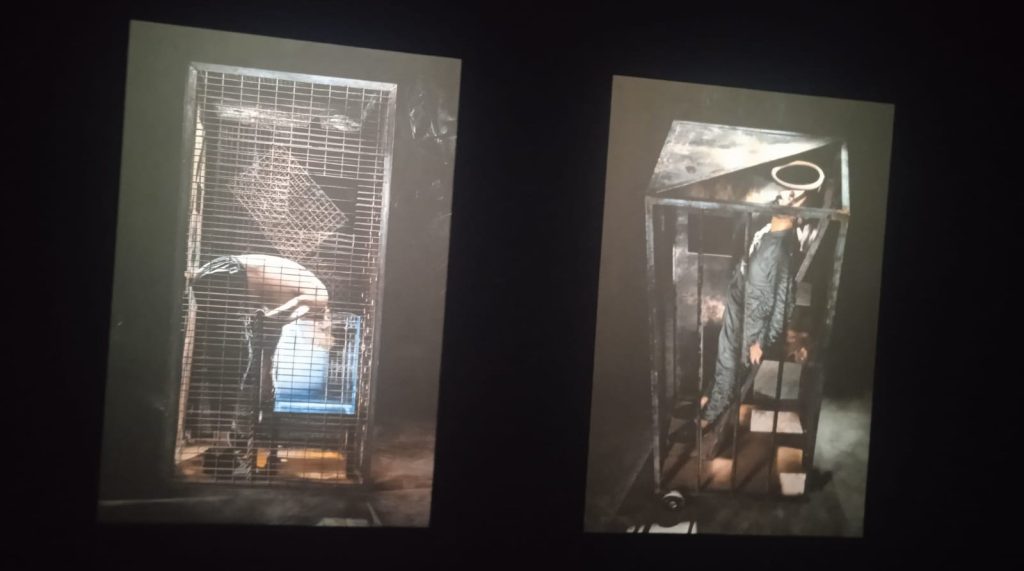
Performance is an area that Vivan Sundaram continuously explores. In the work titled ‘Shelter,’ one can see the out-of-body experiences of the actor Harish Khanna. This art piece consists of eight portraits arranged within a 6 x 4-inch iron enclosure. Saying that human life is lived within an iron cage is not an exaggeration. While this is the subject here, there is still a different perspective. This is both evident and explicit in these works of art.

Contributor