When observing Nityan Unnikrishnan’s artworks displayed at Kochi Muziris Biennale, Deleuze’s phrase ‘To be fully a part of the crowd and at the same time completely outside it, removed from it’ comes to mind. What Deleuze means is not to avoid or withdraw from the crowd, but rather, philosophically, to respond to it. It calls for standing alone beyond the moods of the crowd and becoming a flow beyond its controls. How is it possible to remove ourselves from the crowd, as Deleuze suggests? The crowd is an essential element in the worlds created by Nityan Unnikrishnan. However, the subject is not the crowd, nor is it crowd psychology; it is specific perspectives beyond the crowd, a perspective in which the crowd itself becomes merely a view and content that determines what is out there, distinguishing what is not.
After training in ceramics at the National Institute of Design, Nityan has turned to painting following his long-standing work in furniture design. In Nityan’s creations, where concept and reality are intertwined, the journey across the surfaces of deep visual landscapes becomes an experience embedded with countless subtle stories, carrying the inner energy of tales. As someone who seeks the inner meanings of both individuals and the collective formed by individuals, Nityan can be seen expanding beyond multiple-layered boundaries. Nityan’s works, which are prominent in memory, popular visual culture, and literature, not only mark the creative worlds of a person who is both an artist and a philosopher, but also, through images, descend into the depths of the paintings themselves, transforming these creative worlds into an exploration between life, dreamscapes and memory.
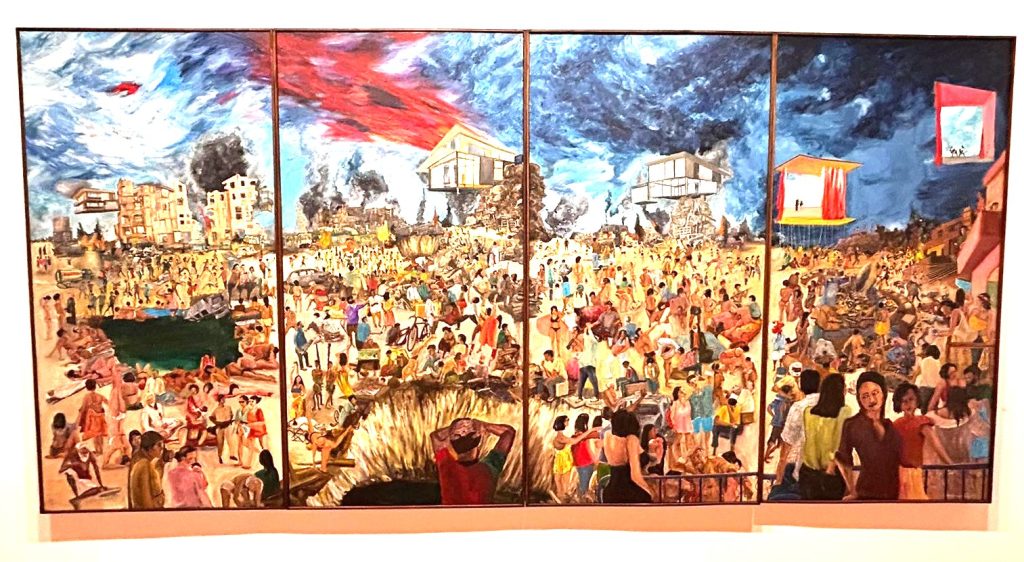
Like the crowds in Pieter Bruegel’s paintings, Nityan’s All of Us (2025) is filled with people. The work, divided into four panels, speaks the language of existence amidst ruin, creating a surreal world through the glimpses of closely packed humans. The four panels are teeming with people, each of whose actions and movements is significant. On one hand, there is ruin, but on the other, there is celebration; semi-nude men and women are enjoying life. Yet, there is an undercurrent of conflict that raises questions about whether that is really the case. In the first panel, we see a group of people enjoying life under parts of buildings that have collapsed and are in ruins. Upon closer inspection, especially after viewing the artwork ‘Hymns for the Drowning,’ it becomes evident that these images represent two kinds of worlds. The question arises whether this can be seen as the duality of Occident/Orient in places of decay. This is a thought-provoking question because it also raises the query of how an artist can create the Occident/Orient dichotomy on a canvas that has been torn apart lengthwise. Additionally, the question of how to transform that idea into a complex work of art is also raised here.
It is clear that humans have created a place beyond disasters, but it is also evident that disasters exist beyond even that. It is there that the works of Nityan intertwine these two realms and take them to new dimensions. While the four panels in this painting form a sequence, it is also evident that they represent four distinct states of being. Life continues to flourish beneath the shattered and crushed spaces; when the question arises about which of these places are destroyed, the question of the stories of the people seen there also becomes relevant. Everyone has their own story. It is when there are stories to tell that one becomes human, becomes history and narrative. Seen in this way, everyone is a story—stories even when silent. It is this awareness, a reality that also causes pain, that is being expressed here.
The six-panel artwork ‘Hymns for the Drowning’ is notable for its personal and powerful political message, while also being dialogical in nature. This piece of art simultaneously tells the history of struggles, while also presenting the interconnected backdrop of exploitation, inequalities, and capitalism. The dissatisfaction that spans six panels, conveyed through the words ‘White Lies Matter (not white lives matter)’ and the proclamation ‘No histories that end in Love,’ is what Nityan describes—what is said without being said—is about worlds of insecurity and imbalance. ‘White lies matter’ is an extremely loud statement. Sometimes, the artist might have felt that it needed to be said that loudly. But beyond that, through the declaration ‘No histories that end in Love,’ we can see that the worlds the artist presents and points to are a continuum of conflicts entirely set apart by the artist himself.
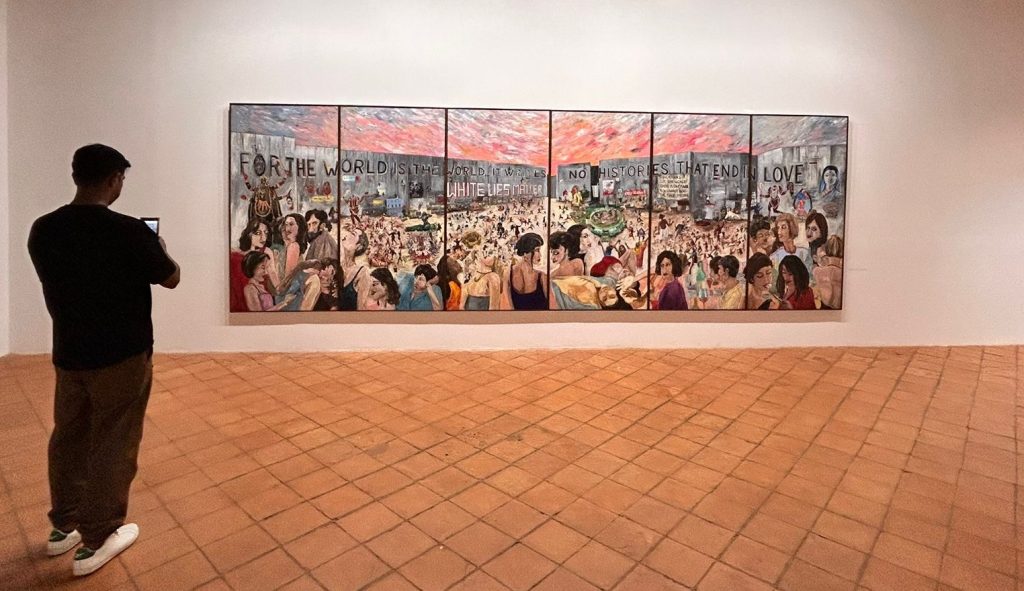
When we look closely at these six panels, just like in the work All of Us, we can see the canvas divided into two streams; at least, it appears that way. On one hand, there is the wall that can be seen as the edge of the canvas, along with its inscriptions and illustrations; beneath it, just like in All of Us, is the flow of human lives—people kissing, watching idly, standing, playing, lying down; there are countless humans. Through various actions and stillness, they are communicating. In the inscriptions and illustrations on the wall, the artist has carefully and clearly recorded his political views. This painting, this series, is notable precisely because of its loud politics; it is clear how loud Nityan’s creations are. Within it, numerous scattered elements are incorporated; for example, many symbols, including the sculpture of Yakshi by Kanayi Kunhiraman, are featured. Upon closer examination, we can see that the formation of the ‘Malayali’ identity occurs through various forms of writing, accompanied by the presence of numerous gods, including Kali. There is nothing in these paintings that is absent. The artist says that it is in the details where the point lies, and each inch, each image speaks about various internal elements, including history, politics, and caste.
Each of Nityan’s paintings is a disaster poem. It can be said that Nityan presents disaster poems poetically. The ruined civilisation in his paintings shows that, beyond disasters and the destruction caused by humans, people continue to live and find joy. However, the lives of white people and the lives of black people divide life into two. Alternatively, it either helps to understand the very creation of that duality or problematises it. Above disasters and calamities, humans, united and together, reconstruct life. It is here that one is invited to reflect on the slowly unfolding early signs of collapse and the strange, trivial nature of destruction. The paintings ‘We have got tonight (2025)’ and ‘Sing you to sleep’ depict scenes of decay from inside the house. The compositions represent a house split apart, with its decayed exterior views visible from inside. Amidst the ruins, the paintings are filled with images of people sitting comfortably, lying down, or sitting still. In this way, these scenes are layered with images within images, inch by inch. These paintings hold scenes that take a long time to observe. They encompass a range of loud political elements, as well as subtle historical, anthropological, and aesthetic perspectives.
Krispin Joseph PX, a poet and journalist, completed an MFA in art history and visual studies at the University of Hyderabad and an MA in sociology and cultural anthropology from the Central European University, Vienna.