
Satyakam Saha’s recently concluded solo at Bikaner House brings together two decades of artistic practice, in his first solo show
While looking at an artwork we often do not see what went on behind the scenes to construct it. Constructs explored how ‘images and ideas are formed, dismantled and reassembled across mediums.’ Held at Bikaner House’s two massive galleries, (CCA, Center for Contemporary Art) from the 22nd to the 26th the exhibition showcased the work of architect-artist Satyakam Saha.
Interestingly it is Saha’s first big solo show in India after a career in art and architecture that spans over two decades. It is not like he has not shown his work from time to time in several group exhibitions, especially with the artists and human rights organization, Engendered, that is directed by Myna Mukherjee. Perhaps Saha never really had the bandwidth to put together the different aspects of his varied practice and present them in this manner that we see at Bikaner at the tail end of the year 2025. One cannot help but wish that show went on for a while longer, given that footfalls are harder during the year-end celebrations.
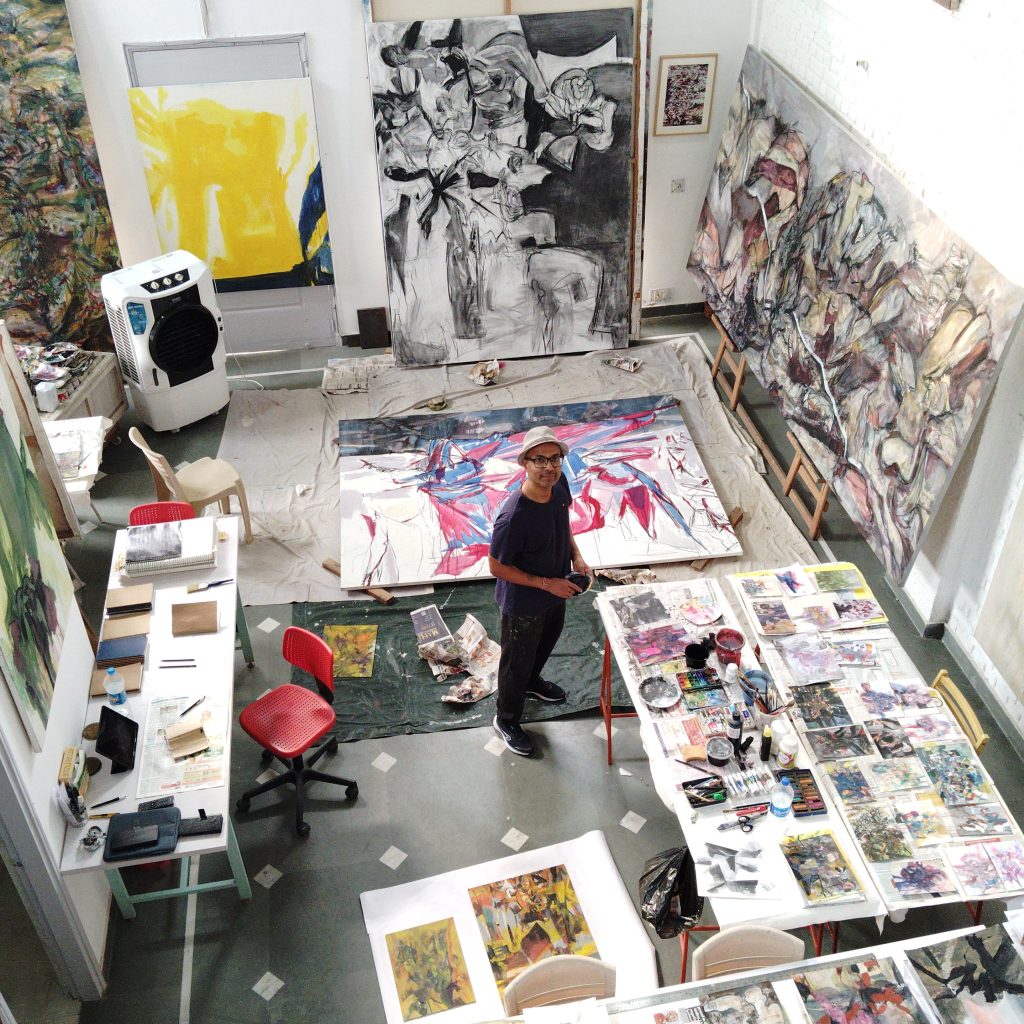
“After two decades of sustained practice, between New York and New Delhi, it felt like the right moment to return to have a solo show in India,” says Saha. “My work has evolved across drawing, painting, sculpture and digital media, and this exhibition brings them together as a cohesive reflection of my journey. The practice now feels ripe to be shared with a wider audience,” he adds.
Displayed on transparent consols, one gets a glimpse of Saha’s sketchbooks, where we see how his, ‘habitual drawings’, evolve into paper models, sculptural forms in clay and later return to painting and collage. “Drawing has functioned not merely as a preparatory tool, but as a sustained investigative practice,” says Saha. We get another glimpse of his drawing process in an animated film, set against a selection of dramatic music. It takes the viewer through a vista of bird dotted peaceful shorelines to exploding missiles, thus exposing the darker side of mankind. One may argue that this is an emotion that underlays much of his work.
One is also treated to a large digital blow up of a smaller linear drawing, of a skeletal form on a skeletal horse pointing ominously at a mushroom cloud. Importantly the skeleton is wearing a large top hat, the kinds worn by the imperial lords of the West and one cannot help but read a third-world protest that underwrites the work; the diasporic artist looks critically at the capitalist practices that have led to the oppression of several third-world nations.
Besides the emphasis on his drawing process, we see several works, that refer to his practice as an architect. Hidden away in magical lightboxes, fluorescent sculptures that glow in the dark, and then large architectural sculptures that almost span two floors, rearing up its head near the staircase that leads to the second floor in the gallery. The sculpture is in fact a reference to his days creating large than life works. It is minimal yet imposing.
An alumnus of School of Planning & Architecture, New Delhi and New York Studio School, Saha builds upon his varied experiences to keep his work open-ended.
“My journey began with a curiosity for art while studying architecture at SPA Delhi, which led me to enroll at the New York Studio School. There, I learned, evolved and deepened my practice. The years that followed have been marked by experience, growth, self-realization and an enduring passion for my art,” says Saha.
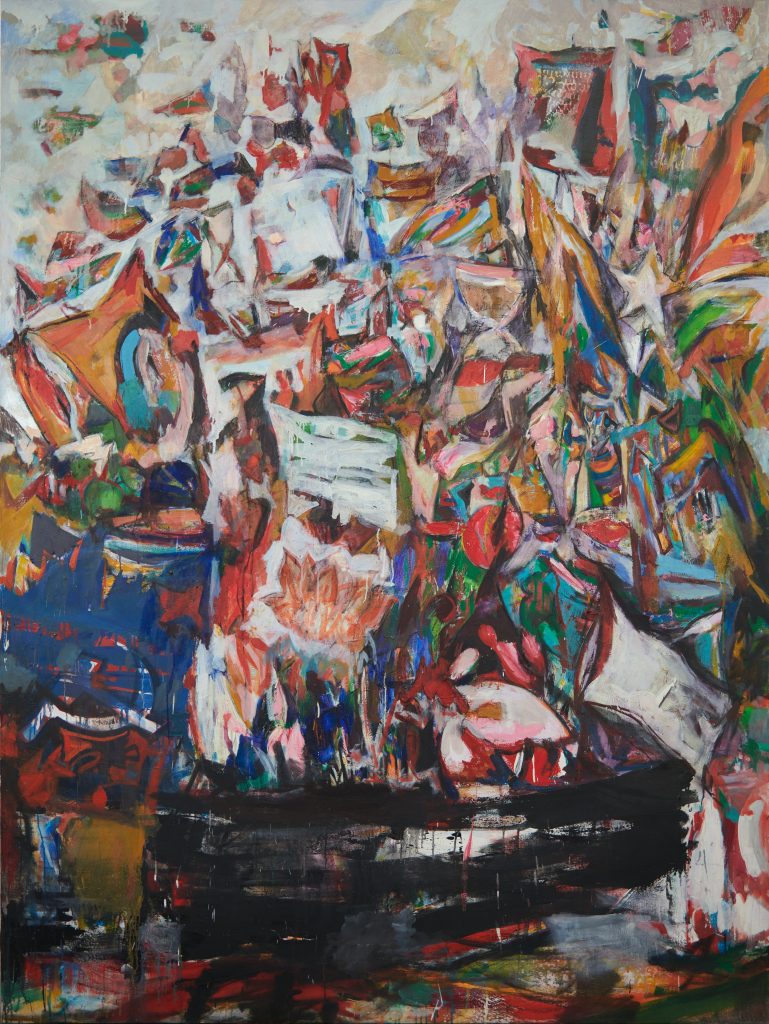
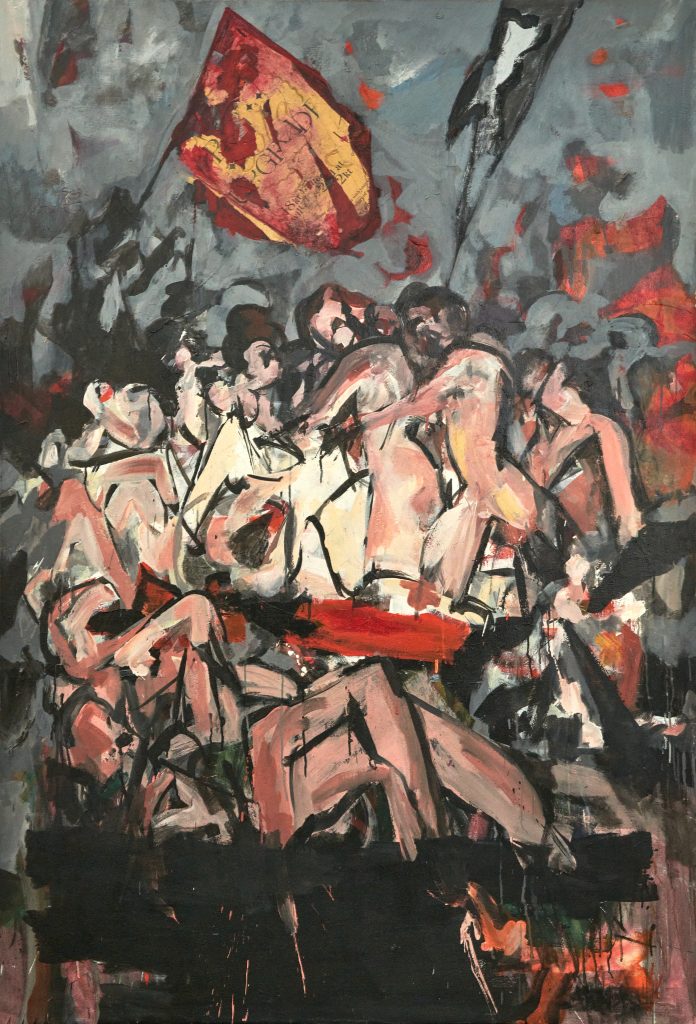
In this show, he brings together accumulations of shapes, gestures and colours loosely merged and dispersed, echoing lived experience, everyday encounters and global events. “Moving-image works extended these explorations into time, creating immersive ‘mindscapes’ layered with drawing, sound, landscape and fragments of news,” says Saha.
Another video that we encounter in the darkened interiors of the viewing room upstairs is one of a vase of sunflowers wilting in real time but sped-up in a filmic manner. It evokes a number of emotions, but the primary overarching idea that one comes away with is a sense of eventuality: an acceptance of mortality, a statement that all living beings bloom and then fade out.
His large-scale paintings referenced the visual language of heroic museum works, while subverting them through abstraction, fragmentation and dense layers of mark-making. Physical landscapes intersected with political terrains, producing compositions that resist closure and singular readings. There is always much going on in Saha’s work and one can be rewarded by multiple readings.
To catch Saha’s work, one could visit his studio in Greater Noida’s Kaladham by appointment: 8802871147
All images courtesy of the artist.
Georgina is an independent critic-curator with 18 years of experience in the field of Indian art and culture. She blurs the lines of documentation, theory and praxis by involving herself in visual art projects. Besides writing on immersive art for STIRworld, she is a regular contributor for The Hindu, MASH Mag and Architectural Digest.