“The real danger is not that computers will begin to think like men, but that men will begin to think like computers.” — Sydney J. Harris
I asked ChatGPT to act as an art professor and tell me what kind of art, in its opinion, AI couldn’t make. This is what it said in a nutshell:
‘AI can generate images, but it cannot craft art that depends on human existence — pain, memory, risk, love, mortality, cultural inheritance, or the stubborn tactility of real materials.
It can be a collaborator, even a provocateur, but it cannot be a witness to the world.’
To be fair, this is more succinctly put than most humans would be able to. So, let’s give credit where it is due. Of the 10 humans I meet in general, almost nine-and-a-half humans are still stuck in that tried and tested answer of the art cretin: “I paint what is inside me. I paint my feelings.” There is nothing wrong with this answer. Just that it can’t help but be more than a ‘paperboat in a puddle’ metaphor in my head – rudimentary and sentimental. Not like a ship sailing in the headwinds of the Pacific.
Any artist worth her or his salt would not hesitate to say that, oftentimes, she or he has more or less no real idea why they make the art they do. Their answer is not a well-wrought urn that would make a John Donne proud. The reason why they make art is almost always an afterthought. Some artists, with spiritual inclinations, love to observe that art comes from a deep meditative space where none but the artist can reside. The problem here is, we don’t know what these words like “deep” or “meditative space” mean. They are open to interpretation. And worst of all, this answer too is a terrible, overplayed cliché.
And here’s where we meet an interesting irony or even a curious conundrum.
Artificial Intelligence (AI) does not display the real ignorance of humans. It seems to be without flaws. Hence, quot erat demonstrandum: in order to be a human and an artist, you must have flawed and done-to-death answers on the rationale behind creating art. Well, like most rationales, this too is problematic and pedestrian. If you consider the large language models that AI machines are based on, they are regurgitating, rather skillfully, all the greatest answers on why we make art. Most of these observations were provided by great creators and artists, who often marvelled at the extent of human ignorance. An AI creates a soup out of great observations that took humans centuries to arrive at. Yes, that’s the best it can do for now.
I have often felt that our inability to be perfect, to know all the world’s books and art, to understand all cultures and the people who inhabit it, and the countless seasons and movements of the human experience, forges in us an imagination that instinctually seeks to launch our intelligence and awareness into a magnetosphere of understanding that is greater than ourselves. We are, if you allow me this flight of fancy, a magnetosphere that absorbs radiation from the Sun, a star that gives us light, but we know precious little about it. And if the star vanishes, we too will vanish with it. Hence, we try to know it poetically. After all, we are natural travellers and we are driven to know the unknown.
I find this condition both frustrating and exciting. We know and feel an impossibly miniscule part of Creation, and this powers our imagination – the seat of art as per our current knowledge. We will never know it all. Even the transcendentalists, who swore by the ‘intuitive flash’, would agree that the imagination has to be put through the grind if you are to find a path to art. And this path is cobbled with stones of uncertainty.
This leads us to the question: if we knew everything, would we need to dream, would we need to imagine at all? And, hence, would we need to sing? So, is it possible that art comes from a place where not knowing is as crucial as knowing?
Here I must alert you to not look at this simplistically. In order to understand how little we know, one must train oneself and learn with an obsessive passion. And from that wise state of not knowing, you are sure to dream with impeccable elegance, simplicity, and an understanding of our condition that may be beyond words or representation. Quite a lot of art resides in that space where you find joy in the mystery, in the subtle, the unsaid, and in those bursts of light that cannot be fathomed. It could be a simple question like, “Why did you use this electric yellow for the sky?” The answer to which would probably be “I don’t know” or at best “it felt right”. In a sense, both the answers mean the same thing. It has an element of instinct in it, the thing that makes us an animal, hence human. And AI does not possess this unique quality of the animal. Not as yet. We are still very far from a true technological singularity. And I believe even if this singularity were achieved, by then humans would have evolved and changed far more (or differently) than its machines. We would then reside in a space yet to be created or even imagined. An AI might become better or more efficient than us eventually, but it will never ‘out human’ humans.
There are many things AI cannot do, at least not convincingly. For example, can you imagine an AI delivering a punchline with the same flair that a good comedian has? Would you like to watch a stand-up session done by an AI? For novelty, yes. But it would not have the expression or a delivery style that we have come to associate with, say, a comedian like Bill Burr. And this is just the tip of the iceberg.
At the end of the day, an artist feels tired or feels pain. The work of an artist emanates from his life. He works from memory, from his station in life. An artist working in Goa would not be similar to an artist working in Iceland. The thing we call ‘life experience’ is exclusively a human thing. AI does not feel the isolation of Van Gogh or the pain of Frida Kahlo. It has no body, no senses, no fatigue, no memory of pain, no sense of place. It is in a non-sensory space, and art is essentially sensual. You cannot get a brooding Goya or paintings like the Guernica or Excavation, which are laden with trauma, violence, existential angst and layers of the psyche merely by pattern recognition. Art rooted in culture, rituals and folklore cannot be created by AI because it is not immersed in that culture. It can depict it, but it cannot create it.
If we are talking about performance art, the kind that has made Marina Abramović a legend, less said the better. It is simply impossible for AI to do it. Besides that, site-specific art and anything that is tactile is beyond the ken of AI. In short, AI can simulate but it cannot create.
If we look at music, the difference is even more stark. Imagine a group of musicians improvising in real time. The spontaneity required to improvise and transfer the energy created while doing it to an audience, is something that is profoundly human. The beauty of musical improvisation requires that quality of being present, without really knowing what might transpire exactly. A Miles Davis concert, where a bum note becomes the right note on account of the note spontaneously played after it, is something that would make AI scratch its head, if it had one. It cannot mimic the chemistry among musicians playing in real time.
If you are talking about art that comes from protest or revolution, which could be moral or political, it would be infinitely curious if AI engaged in it, for AI is neither moral nor political. It has no stake in political or moral positions nor can these ideas emanate from an AI. After all, making a political poster or even an argument is not the same as being physically willing to do something for the politics you believe in. AI cannot “believe” in any such position.
Eventually, we make art because we want to know who we are and what our purpose is. An AI is not in this reality. It does not have childhood scars or broken hearts, and it does not look within itself. Art is most often an inward journey, and this inward journey is not defined by outcome. Most often, a quiet understanding and a sea of silence is where you find yourself while on this inner journey. These are not qualities that can be fed into a machine. At least, not yet.
For many of us, art is a personal testimony, a searchlight that we use to show ourselves what we are – to understand our insignificance and connection to the universe in general. Art is quite often autobiographical, and our stories are unique even when they are universal. These are qualities that a machine cannot emulate because a machine does not grow up, grow old and die. It does not know alienation or loneliness. It has no lived experience.
I believe that art isn’t merely about making something. It is about living a life that encourages and facilitates wonder. It is about trying to see as far as your imagination can take you, beyond the horizon of time and space. It is about reconciling with your flaws and imperfections, and yet trying to grasp that mysterious firefly we call beauty and truth. Making art is, foremost, an act of living the life of an artist. And an AI cannot do that. It can produce perfect pictures, but it cannot live the life that leads you to make that picture. An AI cannot hear that scream through nature that Edvard Munch heard which led him to his masterpiece, The Scream. AI does not feel the panic that Munch felt.
When you live the life of an artist, you are essentially exploring the unknown. And if you know exactly what you are going to do, it is not an exploration. It is an exercise, it is the death of the journey. Not knowing, after all, is not always undesirable.
I think those who make ceramics probably understand this far better than many. Anything made by the human hand carries in it the irregularities of the fingers or the palm. These imperfections, these tactile aberrations are what make art what it is. I don’t think an AI can “feel” this way because you would have to “teach” it to be imperfect. Humans don’t need to learn to be imperfect. It is an inbuilt condition in us.
Most importantly, only we can delight in art. And we don’t know why we feel this delight. This exquisite joy that is sublime, heartbreaking and eternal, even though we survive in moments, always in the present, as we move to our final port. The only way we challenge our mortality is by creating art. By making art, we feel the eternal nature of temporary joy. And this is exactly what AI doesn’t.
So, let us think like us, like humans, not computers or AI. Let us revel in the sunshine of flaws and the unknown. If we start thinking like a machine, it would be nothing more than artificial ignorance.
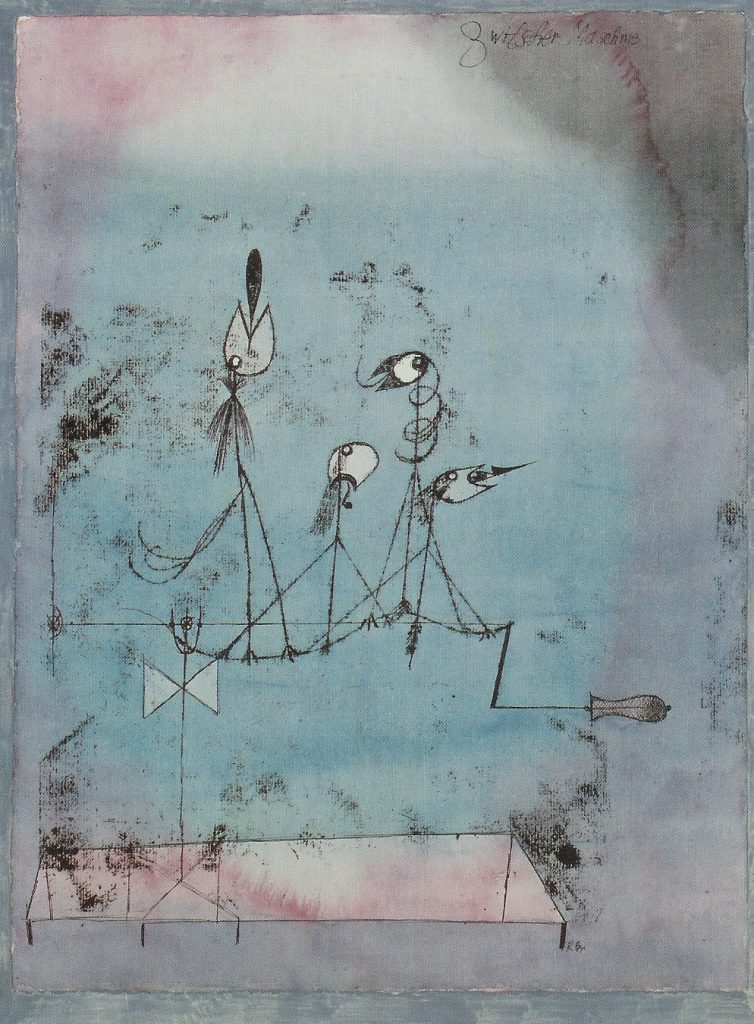
Cover Image: Twittering Machine (Die Zwitscher-Maschine) , a 1922 watercolor with gouache, pen-and-ink, and oil transfer on paper by Swiss-German painter Paul Klee.
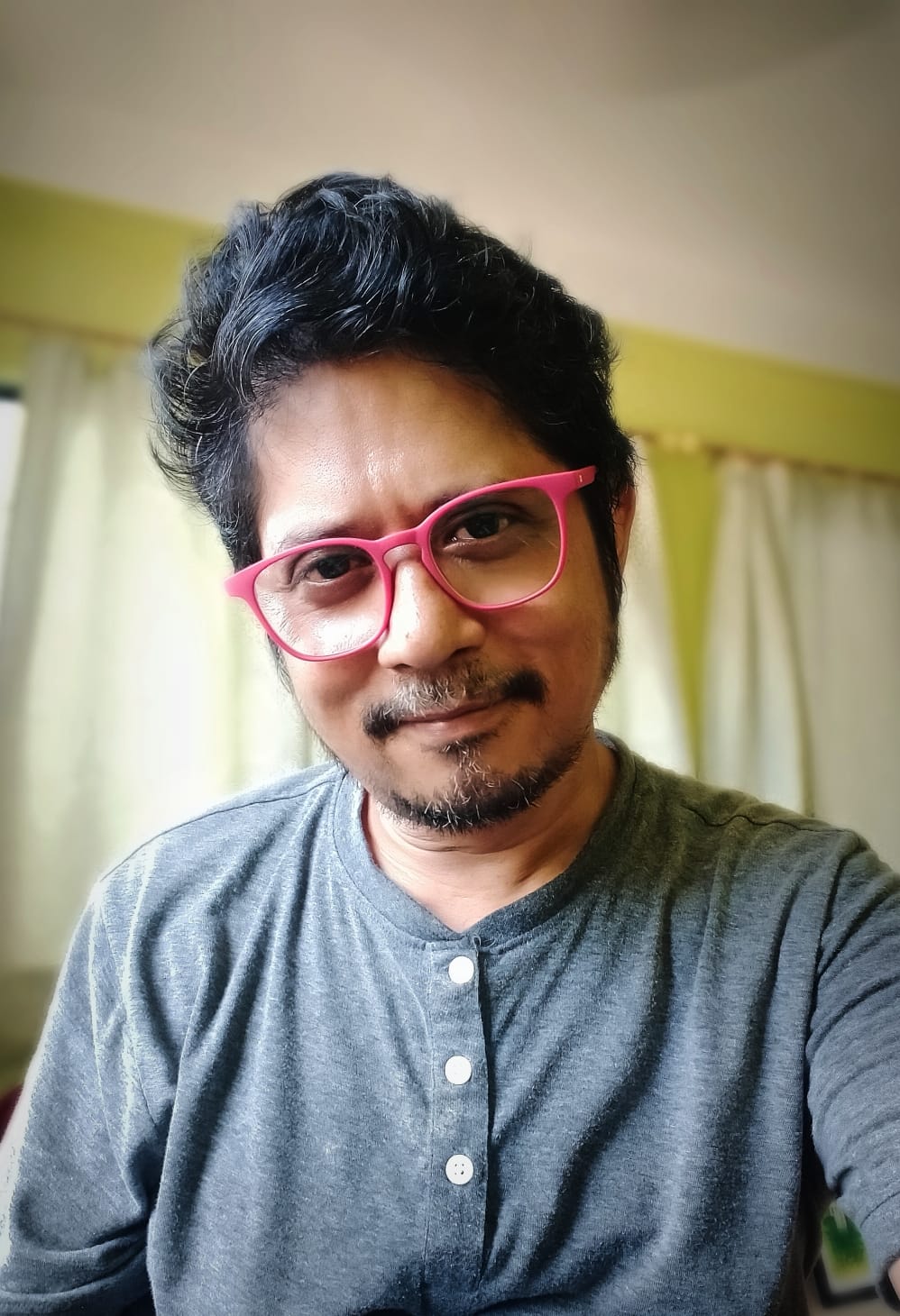
Former Editor at Abir Pothi