Philip Aguirre y Otegui will show his deeply humanistic art at the 2026 Venice Biennale. The artist, well known for combining sculpture, drawing, textiles, and public installations, is expected to present a collection shaped by years of work on social justice, migration, and memory. These themes, which the artist has been following for so long, are especially relevant in today’s world.
The artist Aguirre was born in Schoten, Belgium, in 1961, and his experience of exile is closely connected to his art, his lost land, and his diasporic experiences. Just like his identity, the artist’s family faced many problems during World War II: the mother’s family faced persecution, and his father fled the Spanish Civil War. Such problems have shaped his art and perspective. These family stories of hardship and survival shape his artistic practice, and moreover, he symbolises the problems of the modern era as well as worlds shaped by troubled times of the past. Some of the issues and themes he consistently follows include belonging, fragility, and resilience. Instead of simply showing these ideas, his art brings them to life through unstable shapes, broken figures, and materials that suggest both strength and vulnerability.
The Poetry of the Image
Aguirre‘s description of his art as ‘the poetry of the image’ is remarkable, especially for capturing the tension between strict form and deep emotion. He values drawing as much as sculpting, which he continues to do in terracotta, plaster, bronze, and wood. Through these media, he tries not only to express his inner visions but also to mark his survival. At the same time, an artist who says ‘I draw, therefore I think’ also marks the thinker within him, especially seeing sketching as a way to explore and understand the world, not just as a step before making something else. He often challenges classical traditions by weaving them into his sculptures.
For instance, in Petit Monument, he transforms the familiar equestrian statue, ‘usually a symbol of authority’, into a fragile human pyramid. That is, we can say Aguirre presents a strong yet different view that normally allows one to see authority and hierarchy. One man balances another on his hand, both supported by a horse. The scene feels unstable, suggesting that authority depends on group balance instead of being fixed.
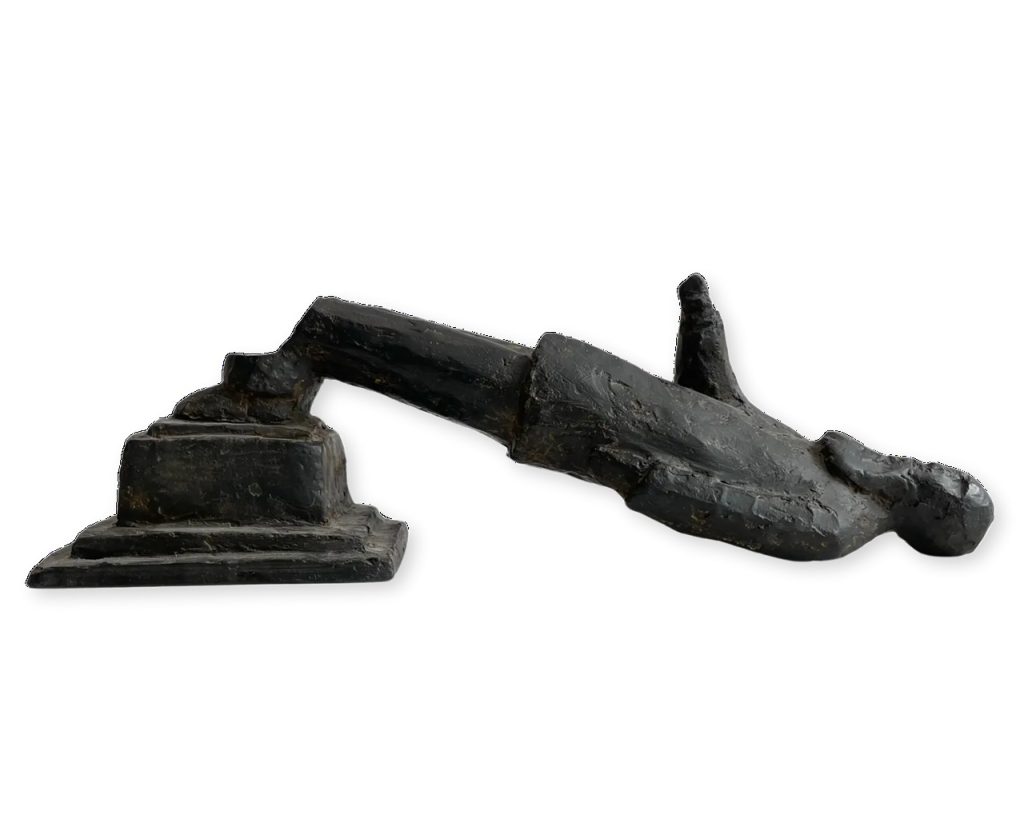
Similarly, the sculpture ‘Fallen Dictator’ appears to be lying on its side, but it shows a monument just before it falls. The artwork explores the instability of power, highlighting the tension between authority and disaster. Instead of celebrating lasting power, it focuses on the moment when dominance fades into history.
Migration, Water, and the Search for Shelter
Aguirre often uses boats, water, and architectural shapes in his art to show the realities of migration and displacement, incorporating his own and his family’s hard journeys, as well as those of his ancestors. Here, water stands out as both dangerous and life-giving. Additionally, sculptures such as Algeciras Acoge focus on human connection and solidarity during difficult times, while the Mare Nostrum series looks at the Mediterranean as a place of both passage and tragedy. One thing that repeatedly appears in the artist’s art is architecture, which also appears commonly, but as a symbol of its absence rather than as a stable structure. The suggested, fractured, or unstable nature of shelters reflects the realities of people without stable housing. His figures, which represent the psychological and physical instability of dislocation, frequently appear unfinished or in transition.
Public Art as Social Practice
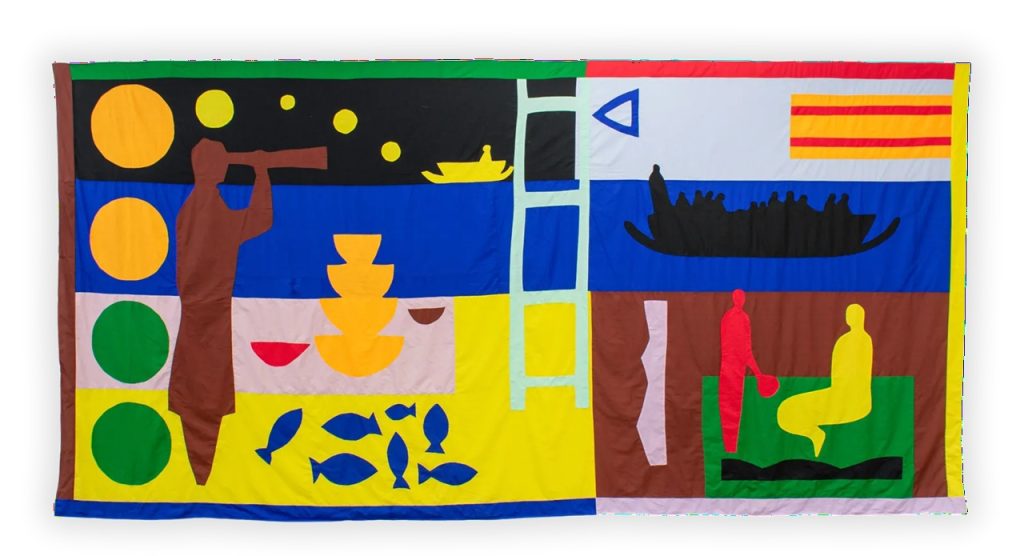
Another important point is that Aguirre has always focused on public spaces in his work. The view that artworks should not be confined to gallery spaces guides him; instead of creating art that stands alone, his installations bring communities together. One example is Éatre Source in Douala, Cameroon, which earned him the 2017 International Award for Public Art. Over nine months, he helped transform a muddy well into a public meeting spot, blending elements of social infrastructure, art, and architecture, creating a space that captures gatherings and conversations in rural areas. He has been involved with Senegal since 1996, working mainly in Dakar and M’Bour, and this experience shapes his approach. In 2022, he created a new collection of vibrant patchwork textile pieces for the Gasthuisberg campus of KU Leuven, working together with tailor Lamine Tounkara. These works are meant to welcome hospital guests and add warmth and a gentle visual touch to the space, offering comfort and a sense of creativity.
The tapestry Hommage à un ami (2023), displayed at a university hospital in Brussels, brings together Belgian artistic ideas and Senegalese craftsmanship. Its lively design, with boats, fish, and a figure looking toward the horizon, hints at movement, hope, and a sense of shared humanity. In these pieces, Aguirre brings his sculptural approach into textiles while staying true to his main themes.
Resistance, Memory, and Collective Experience
Several of the pieces focus on political conflict. Tahrir, inspired by the 2011 Egyptian revolution, shows two figures joined together in a supportive gesture. Although the sculpture is made of bronze, it has a flowing, emotional feel that captures a brief moment of solidarity and makes it last. Like much of Aguirre’s work, it avoids being too specific but still connects to real events, making it a symbol of resistance that many people can relate to. Even his fountains, such as Bruges’ De Bron, carry symbolic meaning. Water flows through stacked basins, suggesting shared resources, continuity, and sustenance. These “living sculptures” highlight his interest in change and connection, focusing on process rather than stillness.
Influences and Artistic Lineage
Aguirre finds inspiration in many places. His art shows the humanist ideas of Frans Masereel, the clear forms of Alberto Giacometti and Constantin Brâncun, and the social awareness of Francis Alæs. Still, he blends these influences into his own style, focusing on making his work accessible and empathetic instead of simply imitating others.
At Venice: A Timely Presence
Aguirre’s art joins a global conversation about inequality, displacement, and the politics of memory at the 2026 Venice Biennale. His textiles and sculptures avoid spectacle and easy answers. Instead, they ask viewers to notice how everything is connected and fragile, revealing this slowly over time.
Aguirre’s work stands out for its quiet focus on human dignity in a field often driven by size and immediate impact. He reminds us that history is experienced through people, relationships, and fragile forms that need constant rebuilding, whether it’s a fallen monument, a careful stack of figures, or a patchwork cloth made with others around the world.

Contributor