This year, the Venice Biennale welcomes a diverse array of artists, among them Mohammed Joha from Gaza. His presence carries special weight in light of the ongoing violence in Palestine. Having weathered the storms of war and the ache of displacement, Joha has become one of Palestine’s most acclaimed artists. Through his art, he embarks on an intimate journey, pouring his singular vision, vivid energy, and unfiltered emotion into every canvas.
Drawing from his life as a Palestinian who has endured the crucible of conflict in Gaza, Joha weaves together painting, photography, sculpture, and collage. His art becomes a tapestry of memory and longing, delving into the complexities of displacement, the ache for home, the shadows of war, and the bittersweet pull of nostalgia.
As a part of the interview series of the conversation with Venice Biennale artists, Abirpothi, featuring Palestinian artist Mohammed Joha. Artist discussing in detail his work and his presence in the Venice Biennale, in parallel with the ongoing war in Palestine.
Q: Your project “Houses of Memory” reflects deeply on the idea of home—how do you define “home” today, after losing physical spaces in Gaza?
Mohammed Joha: “Home,” for me, is no longer simply a physical place. It is bound to identity and memory. After the loss of my home in Gaza, it became something fractured, but still present—carried through memory, daily practice, and small acts of reconstruction. It forms itself through materials and fragments that resist disappearance, rather than through architecture or stability. Today, I don’t see home as a place, but more as a condition of continuity.
Q: You distinguish between “houselessness” and “homelessness.” Can you elaborate on how this distinction shapes your artistic language?
Mohammed Joha: I make a distinction between “houselessness” and “homelessness” because they don’t describe the same kind of loss. Houselessness is about the absence of shelter. Homelessness, for me, goes deeper—it touches displacement in memory and belonging.
This distinction shifts how I work. I’m less interested in documenting destruction as an image and more in how continuity can exist inside instability. Collage becomes a way of thinking through that—through fragments that don’t fully settle, held together only temporarily, using materials taken from lived reality rather than symbolism.
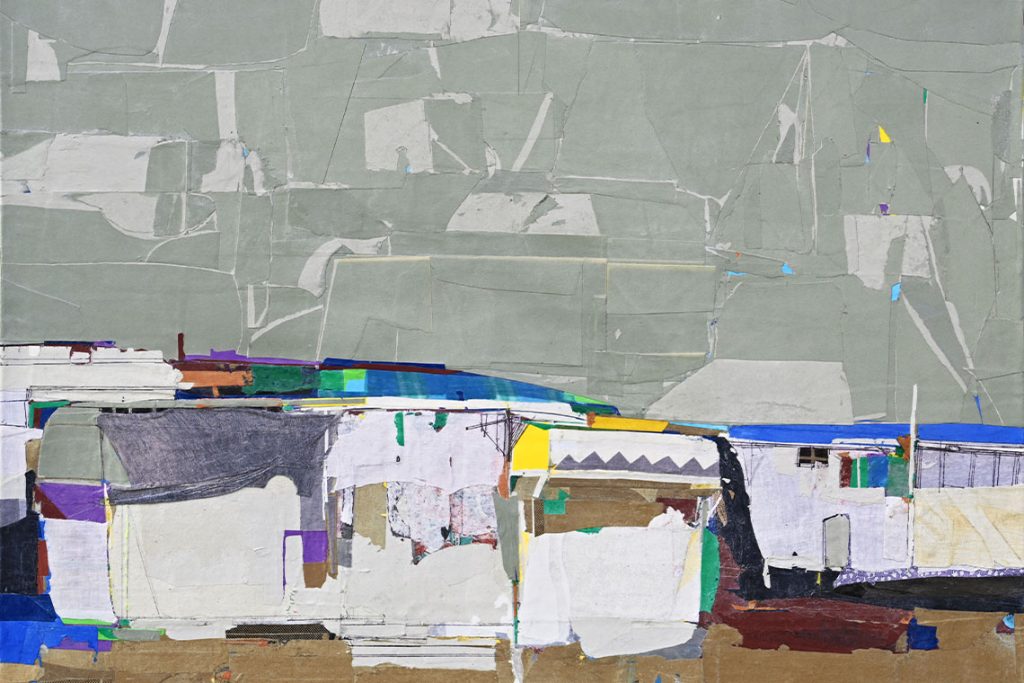
Q: Many of your works depict fragmented or split architectural forms—what do these visual ruptures signify in relation to memory and loss?
Mohammed Joha: These fractured architectural forms come from a break between space, memory, and lived experience. They are not simply images of destroyed buildings. They behave more like traces of how memory itself becomes unstable in the face of loss.
There is always an interruption—something breaking, something trying to reassemble. Absence and reconstruction coexist. I don’t try to repair that fracture visually; instead, I work within it, trying to hold together what cannot fully remain whole.
Q: Having lived through multiple wars in Gaza, how have these experiences directly influenced your artistic process and choice of materials?
Mohammed Joha: Living through multiple wars in Gaza has shaped everything—the way I work, and what I work with. I use what is available, what is left behind: fabric, cardboard, paper, sometimes fragments of personal objects. These materials are not chosen for symbolism.
They come directly from lived conditions. The process itself mirrors survival. Making becomes a response to rupture rather than a way of illustrating it. The work grows through its material traces—through repetition, repair, and constant interruption.
Q: You lost your home and hundreds of artworks in the ongoing war—how does that loss reshape your relationship with creation and memory?
Mohammed Joha: Losing my home and a large part of my work completely changed how I think about creation. It is no longer about preserving objects or final works. It is closer to continuing a process under unstable conditions. Memory, too, is no longer archival. It is fragmented, active, and carried through, making itself. What is lost doesn’t disappear entirely—it reappears in other forms, through gestures, materials, repetition. My practice has moved from producing objects to sustaining a process of remembering while making.
Q: Do you see your work as a form of resistance, testimony, or survival in the context of the ongoing war in Palestine?
Mohammed Joha: It sits across resistance, testimony, and survival, but doesn’t belong fully to any one of them. The work grows from lived conditions rather than from a fixed position. Even so, working with fragments, fragile materials, and reconstruction inevitably carries a sense of persistence against erasure. But I don’t define it strictly in terms of those categories. It is more like a space where making itself becomes a way of continuing.
Q: How do you negotiate the emotional weight of representing war without allowing it to consume or define your entire artistic identity?
Mohammed Joha: I try to shift away from representation as such. The work is not about illustrating war, but working through its traces as part of lived experience. That shift matters because it allows emotional weight to exist without becoming the subject itself. The process of making—through fragments, materials, repetition—creates distance, or maybe a kind of holding space. So my identity as an artist is shaped more by continuity of practice than by the subject matter alone.
Q: Your use of materials like fabric, cardboard, and personal objects is striking—how do these fragments function as carriers of memory?
Mohammed Joha: These materials carry memory because they are already part of lived life. Fabric, cardboard, and personal objects—they are not neutral materials. They hold traces of use, time, and presence. In the work, they are not symbolic. They function as active fragments where memory is embedded in the material itself. Through assembling and reworking them, memory is not represented from the outside—it is reactivated from within the material.
Q: In your work, temporary shelters like tents become recurring motifs—what political and emotional meanings do these forms hold for you?
Mohammed Joha: Tents and temporary shelters appear as both political and emotional forms. Politically, they point to displacement and the absence of permanence. Emotionally, they reflect a suspended state of life—where stability is always deferred. I don’t treat them as symbols. They are structures of lived precarity, where shelter exists, but only temporarily, and life continues within that instability.
Q: What does it mean for you to present deeply personal and Palestinian narratives at an international platform like the Venice Biennale?
Mohammed Joha: It means placing lived experience into a visible space without separating it from its context. I’m not interested in translating these narratives into something universal. I think the specificity matters more than that. What matters is how they are encountered—on their own terms. It is also a way of asserting presence through material, memory, and fragment, without reducing experience into simplified narratives.
Q: Do you feel a responsibility to represent the voice of your community on such a global stage, or do you resist that expectation?
Mohammed Joha: I’m aware of that expectation, but I don’t begin from a representational role. My work comes from lived experience and personal engagement with memory and loss. It is connected to a broader reality, but it is not built as a form of spokespersonship. It sits within a shared condition, without being defined by the obligation to represent it.
Q: How do you hope international audiences—especially those distant from the realities of Gaza—will engage with your work?
Mohammed Joha: I don’t expect a single type of engagement. What I hope for is attention—not interpretation from a distance, but a slower encounter with materials, fragments, and processes. The work doesn’t try to explain everything. It leaves space for viewers to meet it where it is, rather than translating it into something distant or abstract.
Q: Your work often addresses displacement, exile, and identity—how do you respond to the global framing of Palestinian identity through conflict?
Mohammed Joha: I approach that framing with caution, because it often reduces a complex lived reality into a single narrative of violence. My work is not centred on conflict as a defining frame. It is more about how life continues—through memory, materiality, and daily survival. Identity, in that sense, is not only shaped by rupture but also by continuity, rebuilding, and persistence.
Q: In what ways does your art challenge dominant narratives or media representations of Palestine and its people?
Mohammed Joha: It doesn’t respond through counter-image. Instead, it shifts away from spectacle altogether. I work with fragments, processes, and ordinary materials that come from lived experience. This resists simplification and allows for a more layered reading of presence and survival. The aim is not to replace one narrative with another, but to hold space for complexity that doesn’t resolve into a single image.
Q: You describe art as a way to translate memory and resilience—do you believe art can preserve what war attempts to erase?
Mohammed Joha: I don’t see art as preservation in a fixed sense. It doesn’t stop erasure. But it keeps things in motion—memory, fragments, traces. What is lost can reappear in other forms, through material, m repetition, and making. So rather than preserving, it creates a space where memory continues to be activated, even in the face of loss.
Krispin Joseph PX, a poet and journalist, completed an MFA in art history and visual studies at the University of Hyderabad and an MA in sociology and cultural anthropology from the Central European University, Vienna.