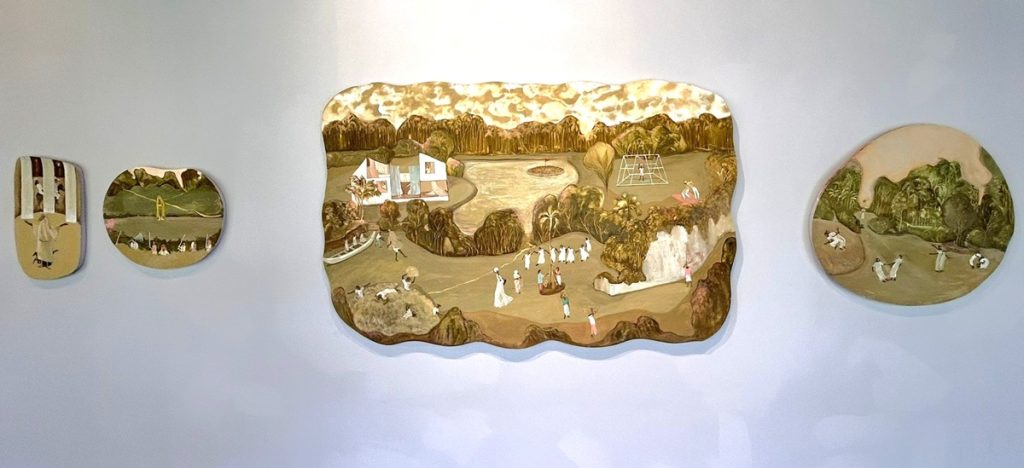
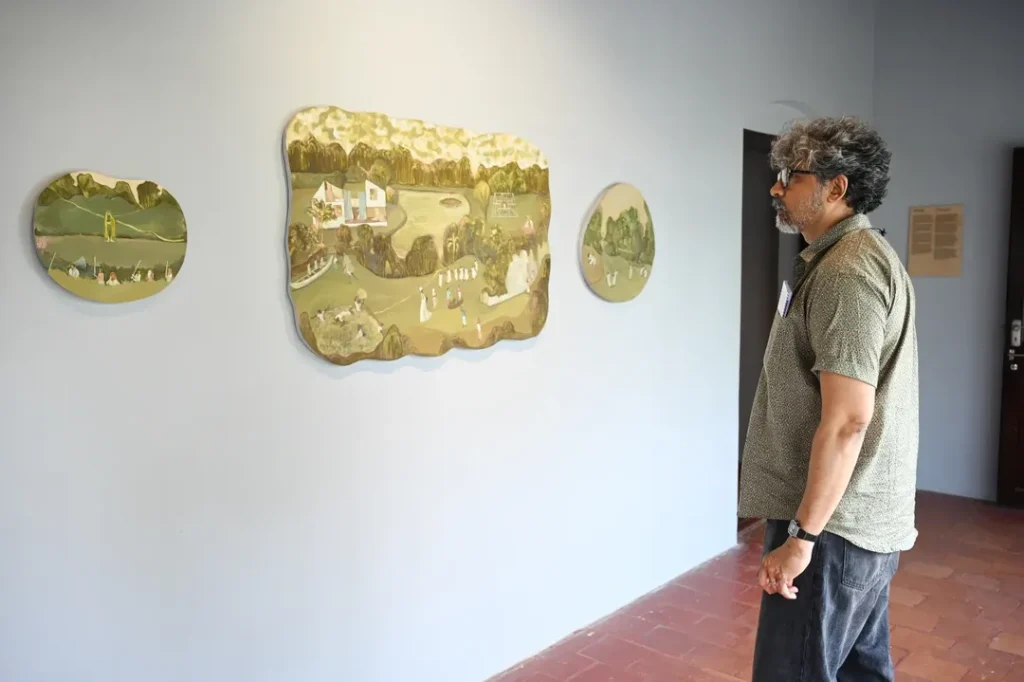
The paintings from Smita M. Babu’s series ‘Paakkalam’, exhibited at the Kochi-Muziris Biennale, traverse the geographical peculiarities of the Ashtamudi Lake shore in Kollam, a region with numerous unique characteristics. Smita’s works, which hint at various aspects related to the coir industry, including occupations, history, and traditions, stand as a testament to how an artist embodies a place within her and transcends it.
Works such as coir spinning and cashew processing have fostered a distinct work culture, and Kollam has a long-standing history of theatre and communism. There are two aspects of coir that immediately stand out as distinctive features of Smita M. Babu, setting her apart from other artists: one is the coir work culture, and the other is her connection to theatre. These two features come together in a way that becomes evident when observing Smita’s artistic creations.
Artist Smith M Babu speaks against the backdrop of the exhibition ‘Paakkalam Serious’ at the Biennale.
1) Your Paakkalam series is deeply rooted in the geography of Ashtamudi Lake. How does the landscape itself shape the emotional and visual language of your paintings?
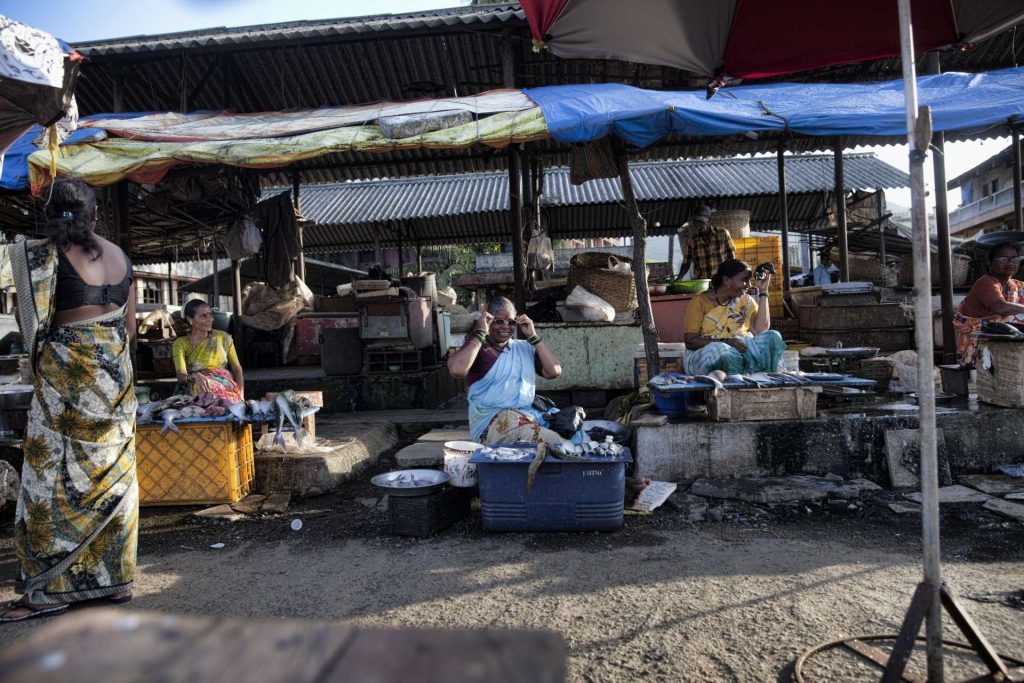
I live in Neeravil, in the Kollam district of Kerala. It is an island surrounded on three sides by the Ashtamudi Lake. Weaving rope (coir out of coconut husk) has been a common occupation in the coastal area of Ashtamudi Lake for a long while. For this, women and children from every household go to places known as ‘Paakkalam’ to make coir. This work is a means of livelihood. It has become a major source of income and financial security for ordinary workers, and the workplace has become the centre of that village. In this way, the coir industry is interconnected. Just as separating golden fibres from a decaying substance and twisting them into new threads (coir), this rope industry plays a major role in intertwining the lives of people involved in various other sectors of that area.
In this modern era, it is my duty as an artist to remind people of that workplace, its conditions, its culture, and its endurance. In a situation where all our social bonds have changed, and people are becoming isolated and exploring things on their own, the Paakkalam series is an attempt to mark the existence of such a period. The sounds of the ‘ratt’ machine and the coir production (making threads out of coconut husk) had become the music of that land itself. My paintings are also attempts to bring the presence of that music into images, recognising that the rhythm within me remains the same.
2) Coir production, especially as a women-centred workspace, appears central to your work. What made you decide to foreground women’s labour and lived experiences in these paintings?
The areas, including my house, were active Paakkalam’s. My father’s and mother’s mothers had done this work. The coir produced there was brought to the coir godowns in Aspinwall, where my works are displayed. This is also one reason for exhibiting the Paakkalam series there. Women came to the coir workshops with children, made spinning cradles, laid them out, and started work. This place simultaneously becomes a space of sharing and joy. When the hands of women spinning coir move, a history is being created there. That physical labour contains a kind of ‘womanly strength.’ Bringing the labour of these women and their relationships, which have often gone unmarked in history, to the forefront is also my political choice.
3) You have over two decades of experience in theatre. How has your theatre background influenced your approach to composition, movement, and storytelling on the canvas?
I started drama training at Prakash Kalakendra, a cultural organisation in my village. I have performed about 30 plays, including Anton Chekhov’s The Bet and Eugène Ionesco’s The Chair, and ‘Theendaripacha’, in which 12 women discuss menstrual politics. Even though I have not studied theatre academically, theatre is a passion, just like painting. Often, the training involved in creating theatre forms has helped shape several of my artworks.
4) Paakkalam is described not just as a workplace but as a space of liberation. How do you interpret the idea of liberation—personal, social, or political—within this context?
Beyond the domestic confines of the household, every field is also a place where women achieve economic independence and self-respect through their own labour. It is a place where people come together beyond social divisions. There exists a community here formed through mutual giving and taking, as well as collective labour. It was in Kerala that, for the first time in the world, a Communist Party came to power through ballot papers. The organised labour movements played the most crucial role in the party’s growth. Among them, coir workers played an assertive role. As a result, the Communist government provided workers with the necessary wages and job security.
5) Your paintings oscillate between personal memory and collective history. How do you negotiate the balance between autobiography and social narrative?
Although the sights in Paakkalam are personal memories, they are also the history of the labour culture of a land and its people. Later, as machines came in, many workers sought other jobs, Paakkalam’s disappeared, and the music of the ratt remained only as a memory. Beyond merely presenting sights, my paintings are also an attempt to mark a culture that is becoming invisible.
6) The dance-like poses of women in your works evoke performance and choreography. Do you see these figures as performers, workers, or both?
The rhythmic music of the ratt wheel makes the workers’ movement as beautiful as a dance. The movement of the hands, the arrangement of the feet, and the sounds in that atmosphere together create a unique music there. In my paintings, nature simultaneously becomes the performing space, and the figures within it become the performers. These paintings are also attempts to bring the possibilities of music and theatre into the painting.
7) Many of your canvases reject traditional shapes, taking on island-like or irregular forms. How does this departure from structured geometry contribute to the meaning of the work?
The paintings have taken on irregular forms as part of an effort to bring natural shapes into images by breaking the traditional confines of the canvas. Memories have no precise boundaries; they lie overlapping one another. The forms, standing apart like islands, represent different parts of my memories.
8) You construct layered watercolour worlds that feel both abstract and grounded. How do you work with layering to create the sense of a ‘genealogical’ or multi-temporal space?
Each layer signifies a different time. When the marks of a new era are placed over old memories, it becomes a record of history. As I visualise nature, the rope of death history, the music of the land, and the rhythm of labour as individual layers, history emerges there like a genealogy. Even when it feels amorphous, hidden within those layers are the raw realities of my land and its people.
9) Your paintings are described as ‘assemblages’ and ‘rhizomes’ in a Deleuzian sense. How consciously do you engage with philosophical ideas of multiplicity and non-linearity while creating?
Although I have not consciously followed Deleuzian philosophies as a theory while my paintings take shape, I realise that the spirit of my art is based on such a ‘multiplicity.’ Each of my paintings is for me a convergence of various times, people, memories, and cultures. The geography of my village, nature, the communist legacy there, and the labour movements of the coir workers—all of this appears simultaneously as layers in my paintings. There is no fixed centre, beginning, or end here. Instead, ideas lie interconnected and spread out like roots. My engagement with theatre strengthens this creative approach. In my ‘Paakkalam’ series and others, people, set against the backdrop of Ashtamudi lake, turn into a rhizome connected by invisible roots. Therefore, these philosophical ideas naturally occur in my creations, whether consciously acknowledged or not.
10) Do you see the Paakkalam paintings as documents of disappearing labour traditions, or as living, evolving visual memories?
My paintings are more than just traces of the past; they are a visual language that constantly dialogues with the present. On one hand, I need to document the nature of death and the culture surrounding it through my work. Along with that, these memories possess a precise vitality. The series’ Paakkalam’ is not an attempt to capture a time that disappears, but rather an effort to project the energy of that era into the visions of the present.
11) How do you translate the rhythms of rural labour—coir spinning, cashew processing, working near water—into visual rhythms on the canvas?
In Neeravil, my homeland, I once awakened to the sounds of ‘ratt’ and the echo of making threads from coconut husk. Those sounds were the music of that land. As an artist, I recognise that the fundamental rhythm within me is the same. The patterns in my paintings indicate these movements. I consciously record this rhythm in the flow of lines and the arrangement of colours in my works.
12) Theatre in your paintings appears not as a separate art form but as something that dissolves into daily life. How do you view the relationship between lived experience and staged performance?
As far as life and theatre are concerned, they are not two separate things. My works visualise life’s deep vibrations within both. Just as light, shadow, and movement on stage tell a story, the colour compositions and each human figure in my works communicate in the same way. In short, in my art, life, and the stage interweave, life becomes stage and stage becomes life.
13) Your works blend events, histories, and gestures across different periods. How do you approach time in your artistic practice—as linear, cyclical, or layered?
In my works, time exists simultaneously at many levels. When looking at a painting, one can see the history of the era, childhood memories, the labour of workers, and contemporary experiences converge on the same surface. In the movements of the people in these paintings, there is the history of that movement. It is neither old nor new; rather, it is something that continues uninterrupted. The layers in my paintings symbolise the layers of time. I envision time as a space where the past, present, and future are interwoven. Therefore, in my creations, time flows in parallel between memories and the present.
14) Finally, when viewers encounter your paintings as ‘rhizomes,’ full of multiple entry points and meanings, what kind of emotional or intellectual experience do you hope they carry with them?
A viewer enjoying a visual art observes it through their own experiences. For someone viewing my paintings, it could be a history of toil, a rhythm of work, or even a sense of theatrical experience. As they traverse the layers in those paintings, they may realise a connection between themselves, the earth, and humanity. In a certain sense, I wish my art to transform into an experience that grows like a conversation, awakening not only the thoughts but also the memories within the viewer, without faltering.
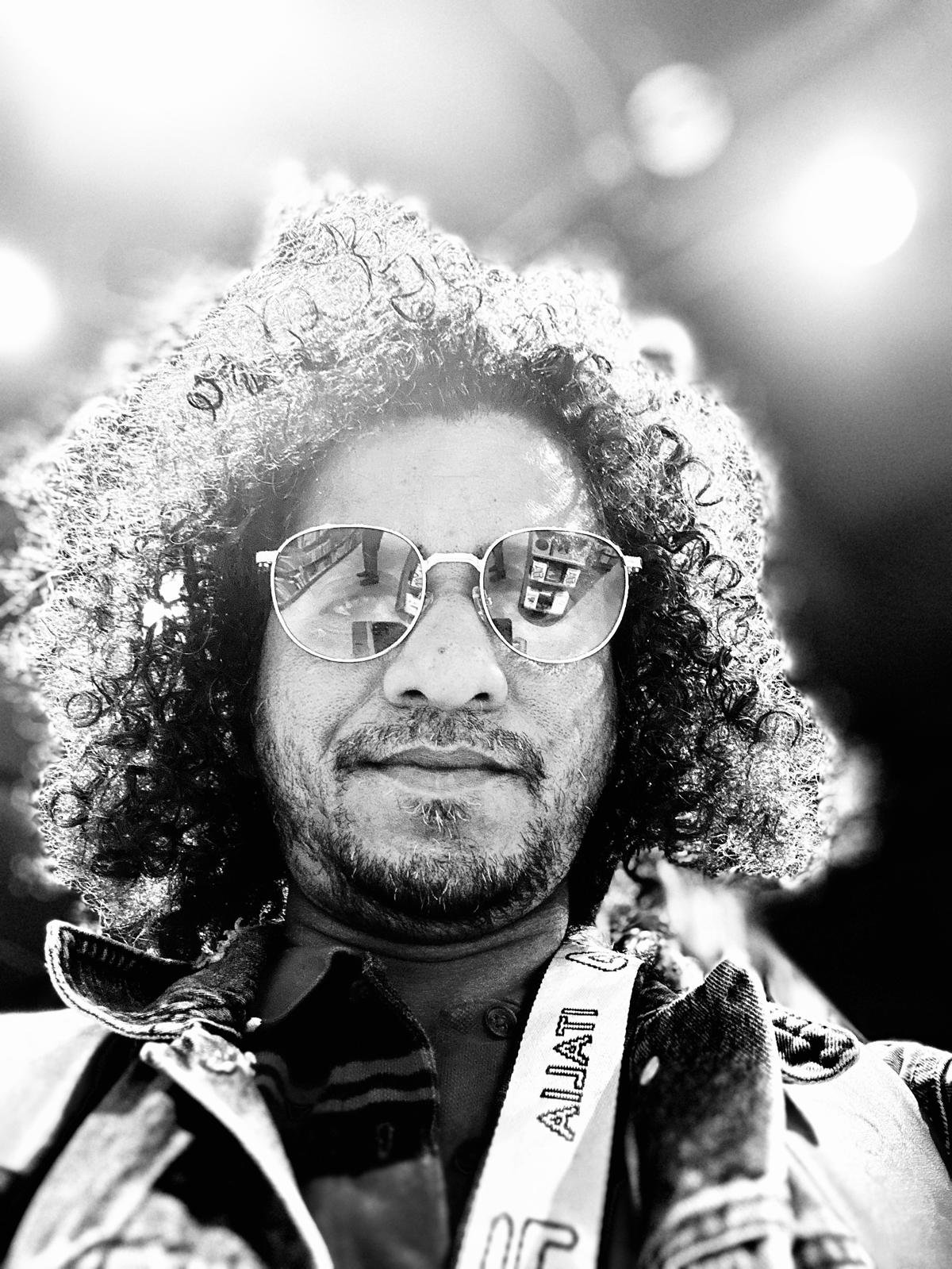
Krispin Joseph PX, a poet and journalist, completed an MFA in art history and visual studies at the University of Hyderabad and an MA in sociology and cultural anthropology from the Central European University, Vienna.