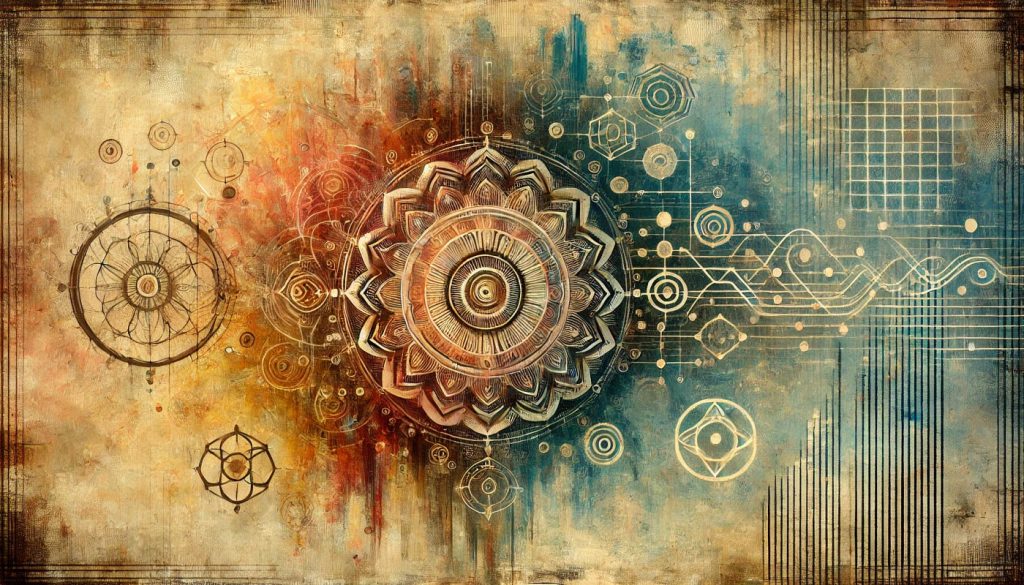
It is quite easy these days to come by an art pattern, which looks like a careful and intentional assembly of geometrical shapes, on bedsheets, on paper, on walls, on phone covers and sometimes also wallpapers. Yes, we are talking about the infamous Mandala Art.
A mandala is a geometric configuration of symbols. These symbols can take on different configurations, such as circular, square or other shapes, but they always share the characteristic of being built around a central point. In the Eastern religions of Hinduism, Buddhism, Jainism and Shinto it is used as a map representing deities, or especially in the case of Shinto, paradises, kami or actual shrines.
Mandala Art and Culture
The art book you came across or the tapestry hanging on the wall is not just a pattern that emerged out of nowhere. Mandals essentially encapsulate the fundamental idea of “wholeness” and “universal dramas”.
In Hinduism, a mandala, or yantra, is primarily a square with four gates enclosing a central circle. Yantras, often smaller and simpler in color, are geometric designs used in rituals that embody the deity’s presence, serving as symbols of cosmic truths and spiritual instruction. They focus on the relationship between the outer (macrocosm) and inner (microcosm) worlds, with each yantra resonating with human consciousness. The term ‘mandala’ originates from the Rigveda and is used in various Vedic rituals, with mandalas playing a key role in tantric traditions.
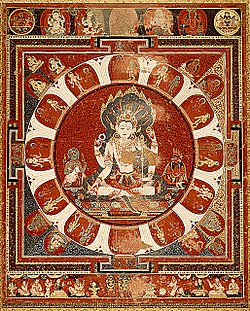
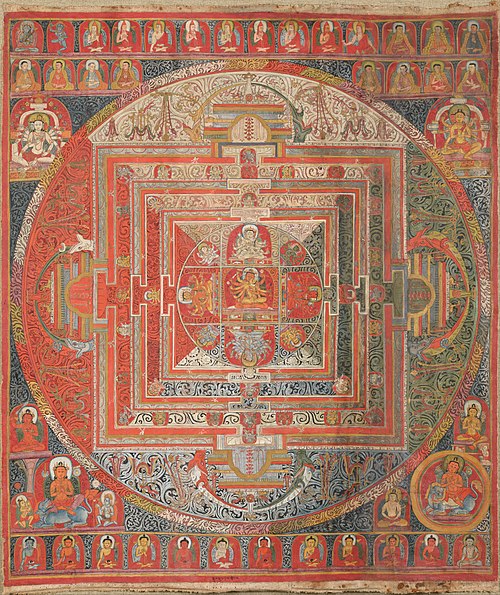
Buddhism however is what gets to be seen more around the art, both as proponents and practitioners. Different Buddhist sects have embraced Mandala in their own unique ways.
In Vajrayana Buddhism, mandalas have been developed also into sandpainting. They are also a key part of Anuttarayoga Tantra meditation practices.
One Japanese branch of Mahayana Buddhism – Shingon Buddhism – makes frequent use of mandalas in its rituals as well, though the actual mandalas differ. When Shingon’s founder, Kūkai, returned from his training in China, he brought back two mandalas that became central to Shingon ritual: the Mandala of the Womb Realm and the Mandala of the Diamond Realm.
The mandala in Nichiren Buddhism is a moji-mandala (文字曼陀羅), which is a paper hanging scroll or wooden tablet whose inscription consists of Chinese characters and medieval-Sanskrit script representing elements of the Buddha’s enlightenment, protective Buddhist deities, and certain Buddhist concepts. Called the Gohonzon, it was originally inscribed by Nichiren, the founder of this branch of Japanese Buddhism, during the late 13th Century.
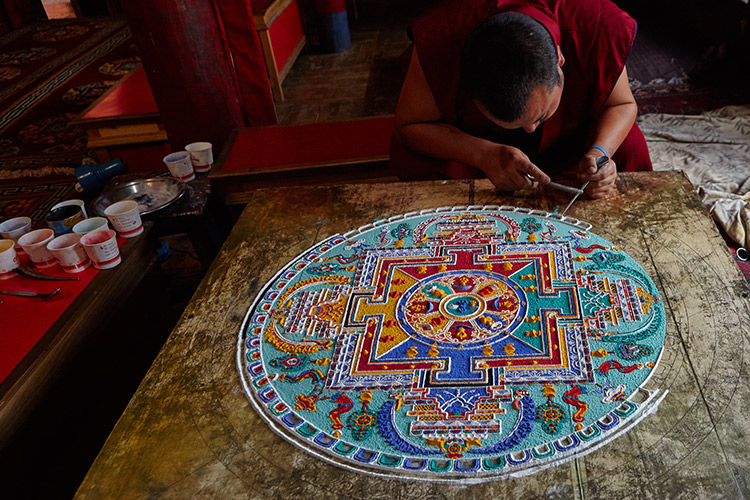
A Buddhist monk working on his mandala
Mandalas have sometimes been used in Pure Land Buddhism to graphically represent Pure Lands, based on descriptions found in the Larger Sutra and the Contemplation Sutra. Unlike mandalas used in Vajrayana Buddhism, it is not used as an object of meditation or for esoteric ritual. Instead, it provides a visual representation of the Pure Land texts, and is used as a teaching aid.
Also in Jodo Shinshu Buddhism, Shinran and his descendant, Rennyo, sought a way to create easily accessible objects of reverence for the lower-classes of Japanese society. Shinran designed a mandala using a hanging scroll, and the words of the nembutsu (念仏) written vertically. This style of mandala is still used by some Jodo Shinshu Buddhists in home altars, or butsudan.
In Islamic arts, the exact concept of the mandala as understood in Hindu and Buddhist contexts does not exist. However, the principles underlying mandalas—such as intricate patterns, symmetry, and representation of the universe—are strongly present in Islamic art through geometric patterns, arabesques, and calligraphy. Islamic art, with its emphasis on non-representational forms, uses geometry to reflect the infinite nature of creation and the omnipresence of Allah.
The Psychological Inferences
It was in the 20th Century that these Mandalas were seen and observed by the psychoanalyst Carl Gaustav Jung. The neo freudian who tried studying the human conscious and unconscious via dreams, ache types and universal consciousness observed that the circle drawings reflected the mind’s inner state at the moment of creation and were a kind of symbolic archetype in the collective unconscious.
Adjoining it with the cultural lenses the idea itself doesn’t fall too astray from the art. Jung claimed that the urge to make mandalas emerges during moments of intense personal growth. He further hypothesized their appearance indicated a “profound re-balancing process” is underway in the psyche; the result of the process would be a more complex and better integrated personality.
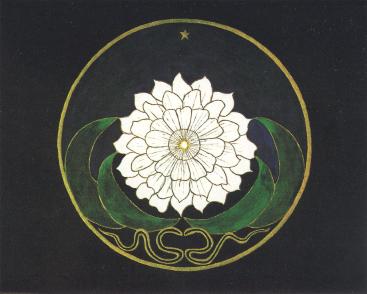
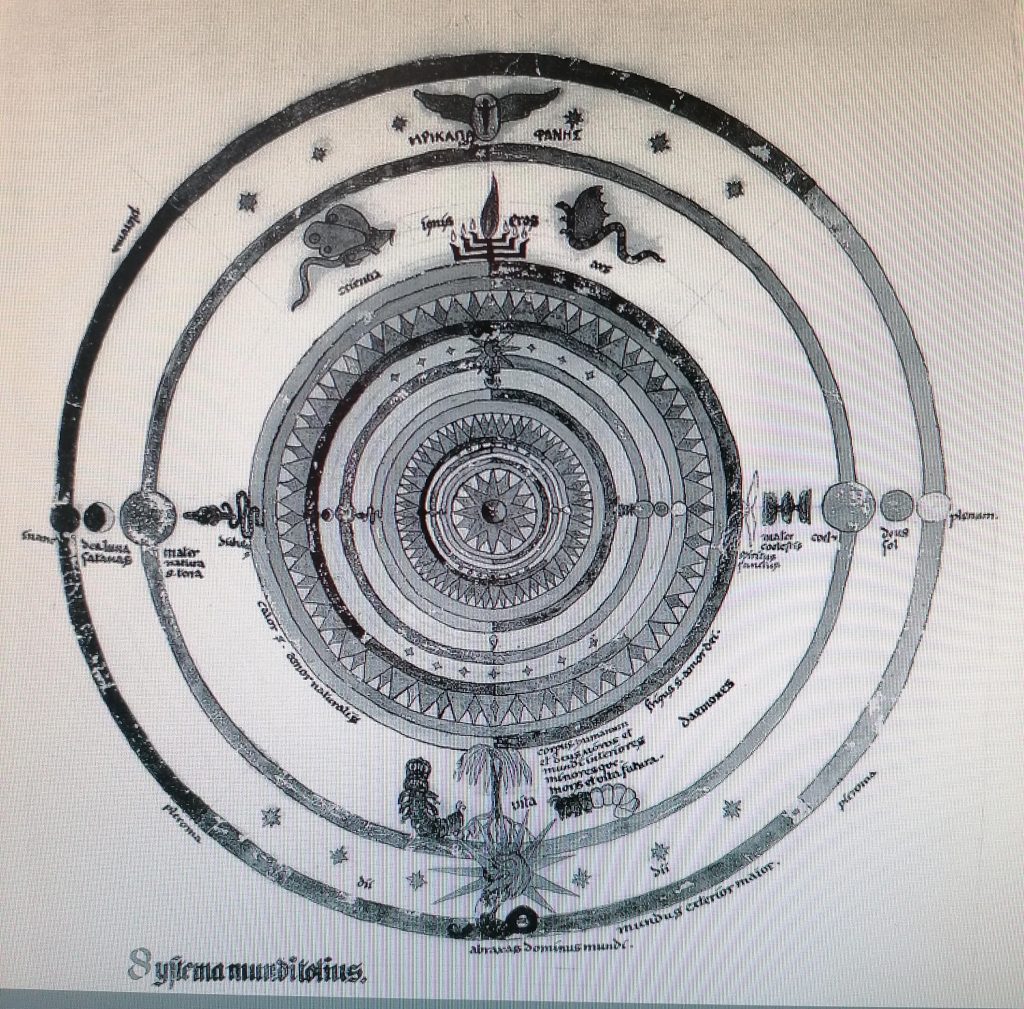
Mandala drawings by Jung’s Patients
Based on Jung’s findings, American art therapist Joan Kellogg subsequently developed a free response test called the MARI card test.
According to transpersonal psychologist David Fontana, a mandala’s symbolic qualities could enable a person “to access progressively deeper levels of the unconscious, ultimately assisting the meditator to experience a mystical sense of oneness with the ultimate unity from which the cosmos in all its manifold forms arises.”
Modern day meditators
Having come this far along the article, one thing we can say about Mandala is that it has been not just an artform but a process and a tool which helps humans uncoil their emotional turmoils.
And who better cares about mental space and emotional well being in today’s date and time than the Gen-Z. Hounded by the stressors of digital media, this generation has learned not to succumb to their anxieties and negative emotions but constantly have the will to speak about it, and find pathways to navigate all their emotions.
Living life in a stimulated algorithm among the constant buzzes and vibrations of notifications, the Gen Z is trying to look for the peace that the buddhist monks live by, which Jung too had supported by studies. And that probably is the reason why arguably the most digitally native generation is and must turn toward something as analog and ancient as mandalas.
They are using it for meditation, for centering the self within the cosmos. The act of creating or colouring a mandala isn’t about producing something “aesthetic” for display—it is about process, repetition, and quiet attention. And that’s precisely what makes Mandala so relevant today.
With the ability to not being able to keep up an attention span of more than 30 secs and scrolling replacing all stillness. Content is consumed faster than it can be processed. In such times, colouring mandalas or creating one’s own patterns gives one a sort of liberty, an act for the self. It slows time down. It demands focus, attention, a sort of precision and a gentle self paced rhythm. Art is so deeply personal that unlike passive consumption—watching reels, liking posts—this becomes an act of creation. It doesn’t require formal training or artistic “talent.” It’s rather intuitive and in flow.
How do you do your Mandala
To get the most out of this exercise, you must first allow yourself to be led by your own innate tendency toward an inspiring image, it’s not so hard for Gen Z to find these, pinterest and instagram being their favorite go tos.
There are many mandala books available today for both adults and children. One can choose the one that most suits their mood by leafing through their pages.
Pencils, markers, brushes, tempera, or acrylic paints are some of the various coloring techniques that can be customized to suit one’s imagination and preferred equipment. The availability of the time and one’s emotions influence the tool selection.
The simplest method is intuitive coloring, which creates a free and spontaneous experience by letting instinct dictate color selections without following predetermined guidelines.
Another alternative is to color from the outside into the center, which represents a journey from chaos to clarity. This option is especially appropriate for people who want to lessen tension and increase concentration.
Starting from the center and working outward, on the other hand, encourages experimentation and originality while providing a sense of progressive construction—a method helpful for honing compositional and logical abilities.
Coloring mandalas is a creative activity that encourages originality and self-expression. Even while many mandalas are geometric, one can produce one-of-a-kind and intimate pieces by using artistic techniques like chiaroscuro, color selection, and shade blending.
This technique fosters creativity and the capacity to convey feelings and ideas via art in addition to developing artistic abilities.
Drawing mandalas is a fun and relaxing activity for all ages! No prior drawing skills are necessary, and one can start from wherever they want to. And perhaps most importantly, mandalas don’t demand perfection. There is no “right” way to colour them and any one can do it. So what’s stopping you? Pick up your pen and a paper and as an act of self care, make yourself some mandala for mental health’s sake.

Aditi Shah Kunjam. An aspiring psychologist, storyteller and poet from the Gond tribal community. Exploring emotion, identity, and culture through a creative lens. I write about art as experience—where aesthetics meet feeling, feminism, and everyday life. Observing deeply, creating thoughtfully, and finding meaning in the details.