The biggest art festival in South Asia, the sixth Kochi-Muziris Biennale, is nearing its conclusion. When the sixth Biennale comes to an end, the question of what the Kochi Biennale is should be shared and reflected on. I am taking this as my task to think about, so this is just a dialogue, a personal narrative, the thoughts of a viewer who has been watching the Kochi-Muziris Biennale since the first edition.
The Biennale has presented a world of art so expansive, multifarious, and nurturing that even the average art lover might relate to it. By the end of the sixth edition of the Biennale, anyone can understand that installation, conceptual art, and performance have all contributed to transforming the viewing experience of art. The slogan “the people’s Biennale” embodies the Biennale’s democratic, inclusive ethos and its ongoing commitment to it. Kochi Biennale encouraged people, especially those outside the art areas, to become art explorers.
It is particularly noteworthy that the twin port cities of Fort Kochi and Mattancherry, in Kochi, were elevated to global prominence through merging art and tourism. The Biennale was designed to incorporate the heritage of the ancient port city of Muziris, making it part of the narrative, beside the larger project of colonialism. By making this historicity part of the Biennale, it has turned the Biennale into a grand event, with heavyweight projects and local cultural explorations.
Idea of Kochi Biennale
The book ‘India’s Biennale Effect: A Politics of Contemporary Art’, jointly edited by Robert E. D’Souza and Sunil Manghani, is a good introduction to the question of what the Kochi-Muziris Biennale is. What is said about the Biennale by the editors in the introduction of this book is noteworthy. The editors argue that the inauguration of the Biennale and its ‘effects’ is not merely about the art festival and its management. The term ‘effect’ should be understood in terms of its impact on and relationship to the local and regional economy. Not only have Mattancherry and Fort Kochi, twin port towns in Kochi, carved a place on the world map of art, but their history and heritage are also presented in a new dimension and subjected to new scholarship.
Some important points are discussed in this book, as the identity of Kochi as a locality for inhabitants, tourists, and traders is like a large canvas that presents its expansive history, a rooted past, and the layers of community diversity to the visitors. The question of what the Biennale is raises numerous aspects, from the economic factors involved in creating an event like the Biennale to cultural, tourism, and educational factors, and to the democracy of visual culture. The book is catalogued in the thematic space titled ‘The Biennale’s effect’.
Effect of Biennale
The Biennale is not designed as an exhibition held in a single location. It is a chain of exhibitions held in many port cities, including colonial-era warehouse spaces. To see the Biennale, you need to visit Fort Kochi and Mattancherry. The region and the exhibition are so intertwined that they cannot be distinguished from one another. One needs to travel to see this exhibition, and staying for four or five days has played a crucial role in balancing the local economy there. When the economic aspect is considered, the question of how the ‘view of art’ has been renewed becomes relevant—the question of whether it has, in fact, been renewed.
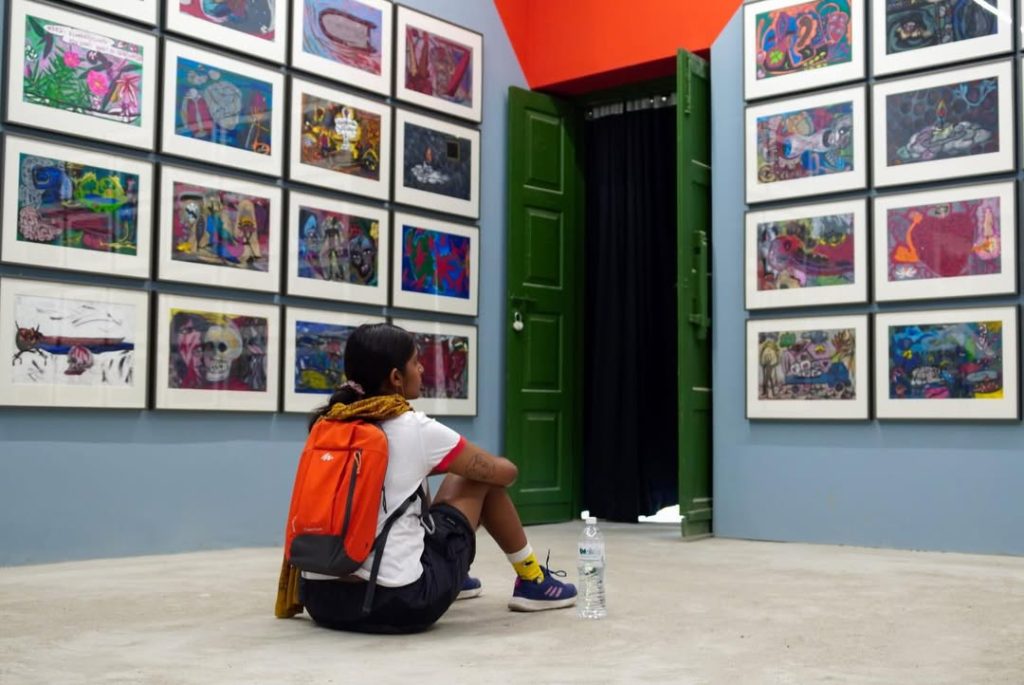
The Kochi-Muziris Biennale Foundation itself argues that recent editions deliberately moved away from the Biennale as a singular ‘finished’ exhibition event. That is, instead, art is presented as an evolving ecosystem—installations, performances, and collaborations unfold across Kochi’s streets, heritage buildings, and public spaces. The essence is that art, which usually happens in gallery spaces, is being seen as occurring in many places, intertwined with locality and its history. In this way, the local space becomes part of the artwork, and the artwork intertwines with aspects of the local place, including its heritage, politics and memory.
We can see that the idea of an artwork is not only about viewing the art but also about how art comes into being. At first glance, it may seem that the Biennale’s surroundings shape its views on art.
Art of Panjeri Artists’ Union
A work of art is a creation of its time; it is something that is completed only through its viewing. In a work of art, the time and the issues of that time are reflected. For example, the artwork of the Panjeri Artists’ Union, an anti-caste art collective, titled ‘Assemblies of Hope Amidst the Death-Worlds: A 100-Day Work Proposition,’ deserves special attention in this regard. A collective of fourteen members backs this artwork; therefore, at least fourteen dimensions are being created and displayed. However, beyond that, it is an artwork that inspires one to think about the difference and relationship between artistic practice and artivism.
The art collective, formed in 2021, is located in Uchu Amtala, West Bengal, on the India-Bangladesh border, and works from a region shaped by the consequences of the 1947 partition. While borders, as we know, are not merely spaces of conflict, members of the Panjeri Artists’ Union focus on ‘border realities’, including continuous surveillance, restricted movement, violence under security regimes, and disputes over shared rivers such as the Ichamati. Across multiple layers, this collective project explores how both countries, their borders, the people living there, and even the concept of ‘border’ itself have shaped their lives in ways they may not even be aware of.
Parliament of Ghosts
The installation ‘Parliament of Ghosts‘ by Ghanaian artist Ibrahim Mahama is notable for its politics. It can also serve as an answer to the question of how to understand and engage with an artwork. This artwork contains only chairs lined up in a room covered with sacks. However, the artwork depicts contemporaneity with multiple layers, filled with history and the ghosts left behind by colonial rule. In this work, you can sit silently, relax, and/or check your phone. The main thing this work primarily advances is the world of dialogue. From silent stances to sitting, while looking at the phone, from selfies to lazy walks, all these can be seen as different states of dialogue. But we can have serious dialogues that touch on topics like post-coloniality, especially when this work brings them to the fore. The explanation given by the artist for using the materials here, especially jute sacks, is as follows: Changes in ownership over time, the marks of grain and spice production, rough histories of resource extraction and unequal returns, and so on, as well as the space being furnished with rows of discarded chairs from public institutions.
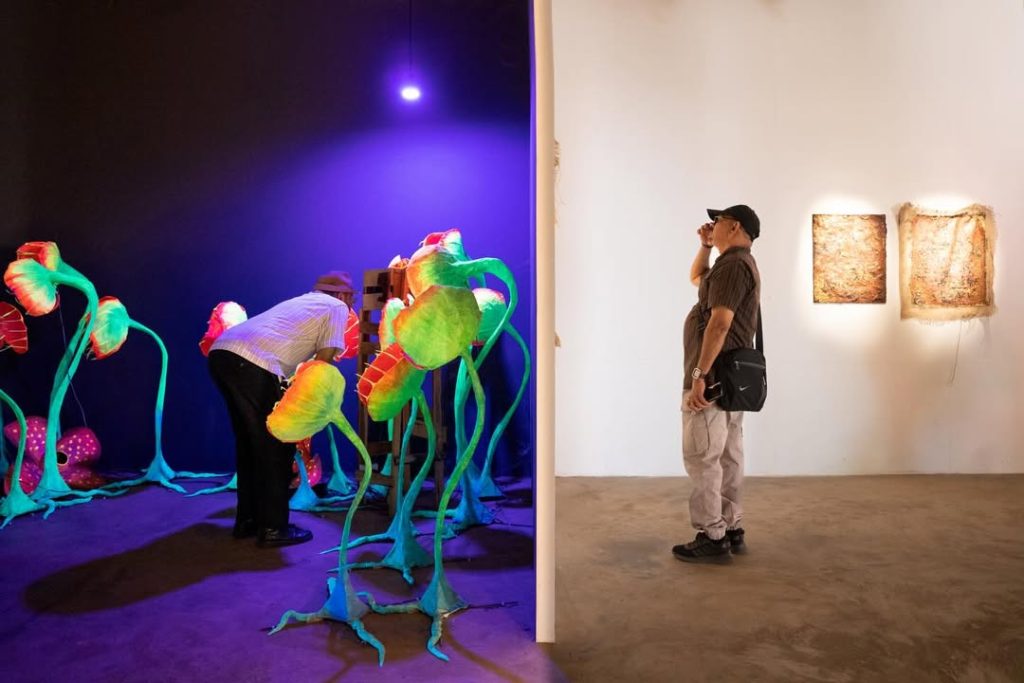
The students who are part of the Biennale are remarkable for both the participation of art students from various art institutes in India and the artworks they present. The show ‘Tension of Belongings,‘ which is part of Students Binalay, features young artists Gorle Lokesh Kumar, Vaditha Hari Naik, and Ponduru Yogeswar Rao from Andhra Pradesh. The project draws inspiration from the collective memories of a community that migrated from different parts of India to Andhra Pradesh, using art to examine the subtle frictions and harmonies of cultural assimilation.
Only the Earth Knows the Labour
Birender Yadav’s ‘Only the Earth Knows the Labour’ is an artwork that renews the concepts of art. This artwork, which examines labour culture and effort in the Indian context, including their burdens, is a multilayered composition with as many entry and exit points. The installation is characterised by its use of industrial and terrestrial materials—iron, earth, and coal. However, these materials are not intended for their conventional meanings; instead, they are prepared to suit the artist’s own logic. Yadav’s choice of materials is never arbitrary; they represent the weight of the “resource curse” and the physical toll of manual labour. The work frequently blurs the distinction between the tool and the hand.
Like Gold and Ghost Ballad
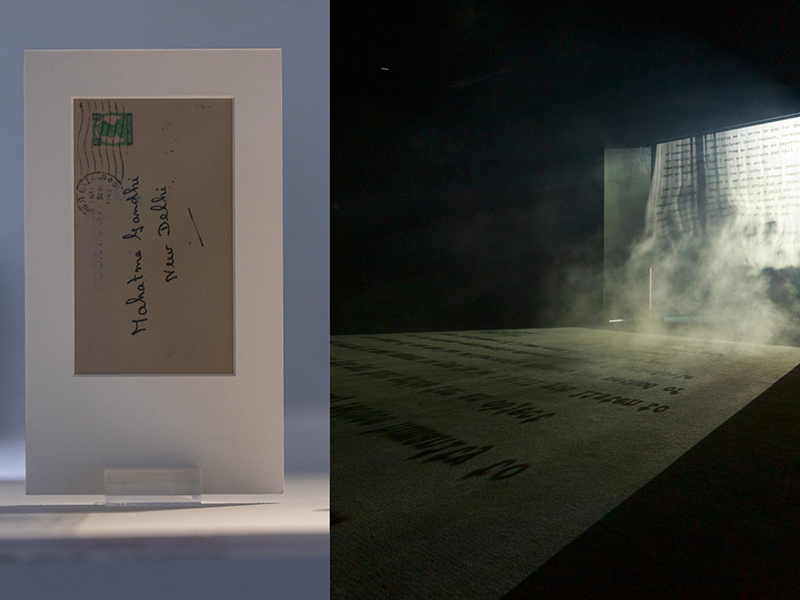
‘Like Gold,’ the colorectal show in Binale, is a notable work for its thematic distinctiveness. In this curated group show, one can see how a set of artists’ creations is uniquely highlighted in thematic settings. In this exhibition, which is extremely meticulous about thematic diversity, each artwork on display problematises the material ‘gold’ in various ways. This group show features several remarkable artworks, including the celebrated photographic project Being Gandhi by the artist Cop Shiva.
‘Ghost Ballad’ by Indonesian artist Jompet Kuswidananto is a remarkable work, both in its presentation and its subject. This site-specific installation at Pepper House marks the journey from dictatorship to democracy and brings together once-thriving, banned music and performances. The work uses his signature objects of ‘bodiless’ figures to gather the fractured chronology of Indonesia, acting as a bridge between the Malabar Coast and Java. There emerges, through this artwork, a connection among Indonesia, the Malabar coasts, and even Goa, which may sound like a ghost story, and it’s a musical one at that.
Smitha M Babu‘s works in the ‘Pakkalam’ series follow a practice that merges Kerala’s social conditions with issues including theatre, coir work, and women’s survival. Smita’s works, which hint at various aspects related to the coir industry, including occupations, history, and traditions, stand as a testament to how an artist embodies a place within her and transcends it. Works such as coir spinning and cashew processing have fostered a distinct work culture, and Kollam has a long-standing history of theatre and communism.
If the primary question addressed here is how art is seen, then it must be said that each artwork shapes the viewer and their perception. Ibrahim Mahama’s work engages the audience through its conceptual strength, reflecting the collective effort of the Panjeri Artists’ Union. Students’ Biennale points to slightly stronger, unexpected sites of creation. Birender Yadav’s work shares the internal conflicts of labour processes. In any case, each artwork in the Biennale is formed and communicates within the conceptual framework it presents.
Krispin Joseph PX, a poet and journalist, completed an MFA in art history and visual studies at the University of Hyderabad and an MA in sociology and cultural anthropology from the Central European University, Vienna.