India Art Fair 2026 features one of its most vibrant and varied artist lineups to date, with up-and-coming artists and new voices expanding the parameters of South Asian contemporary art. Curators, collectors, and critics have taken notice of a particular group among the hundreds of artists participating in this year’s event; they each contribute a unique visual language, experimental style, and compelling thematic depth.
These artists embody India’s evolving artistic landscape through their daring conceptual frameworks, intensely personal storytelling, and material-driven investigations. The artworks of Poorvesh Patel, Kulpreet Singh, Mayadhar Sahu, Sandilya Theuerkauf, and Promiti Hossain are simply irresistible, regardless of whether you are a serious, seasoned art enthusiast or a first-time visitor.
These five artists collectively epitomise the spirit of our time and inventiveness and creativity that characterise India Art Fair 2026, making them must-see destinations on your viewing itinerary.
Poorvesh Patel: Landbound- Love and Labour
Poorvesh Patel, a Gujarat-based artist, is trying, through his very abstract art practice, to trace the tremors of the Earth and heal the wounds humans have inflicted on it. ‘Human settlement began not with conquest, but with listening’ is the vital message he is trying to convey through these artworks. However, the message we need to find is through a meticulous engagement with the artworks exhibited at the India Art Fair. It is noteworthy that the artworks Poorvesh presents demand a very nuanced engagement from the viewer. The works presented by Poorvesh at Dhi Art Space (Booth no: L04) are a magnificent expression of art, its ambiguity, and the beauty of its abstraction.
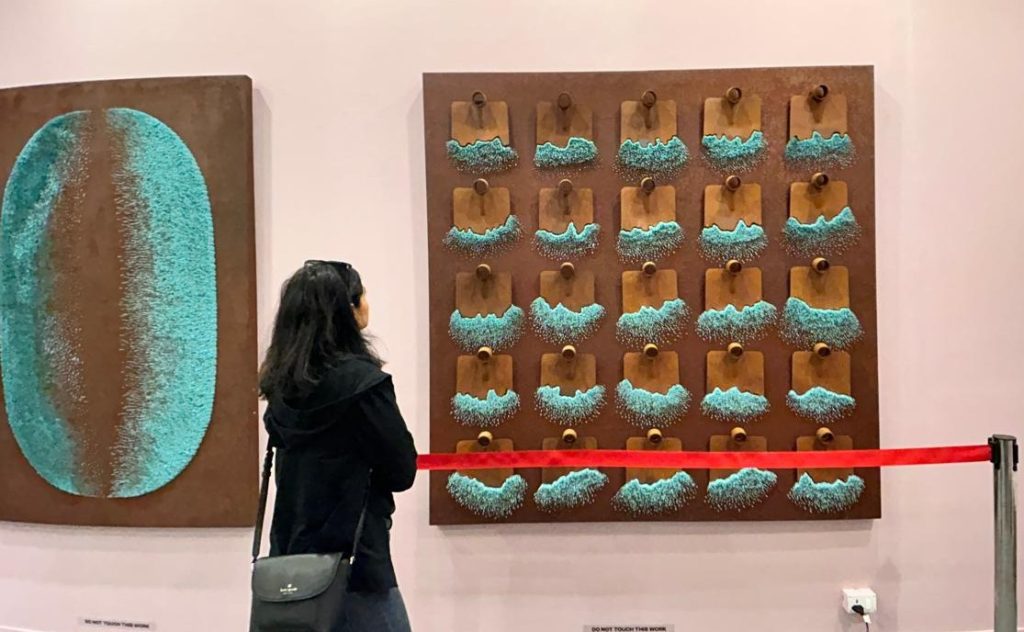
Hearing the Earth is also an abstract act, and its response, as artists, says it can be even more abstract. Thus, one needs to understand the art the way we know the land, the seasons, and the quiet logic of cultivation. Since we know the transitions occur over the Earth in multiple layers, ‘the Earth’ demands attention on all levels from us. Agriculture turned nomadic humans into settlers; subsequently, soil became structure, and tools became social order. Consequently, the land became more than just ground; it became a border, a weapon, and a witness to a changing social order and hierarchy.
While Capital, control, and forced migration represent the continuation of power over land, they also soak the soil with ambition, blood, and greed. Yet, alongside this power/hegemony, another harvest grew on the land: stories of labour and love, attachment and dispossession, argued by the artist. An idea from the curatorial note, “Land holds memory as much as seed”, can be considered as a preface to Poorvesh’s artworks.
Kulpreet Singh: Extinction archive
In the video featured by KNMA, artist Kulpreet Singh introduces his art creation ‘Extinction Archive’ by saying, ‘When I was a child, I used to see vultures. Suddenly, they disappeared.’ It’s not just birds and animals that have disappeared from our surroundings. Rivers, trees, and plants are all part of that list. The Extinction Arch project has attracted attention amid concerns that humans may also become extinct. It is worth noting that what is conveyed silently, yet artistically, is the contemporaneity of fear.
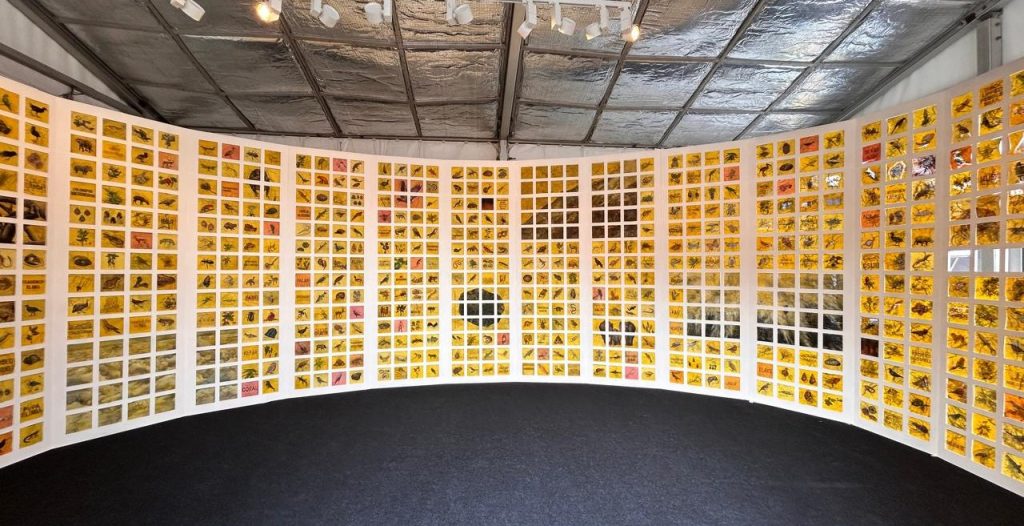
The installation, which depicts animals and plants at peril and spans over 900 endangered species, painted on pesticide-dipped rice paper, makes the magnitude and accumulation of what is vanishing clear. It consists of square panels with rice paper, laser dots, and stubble burning ash that represent the innumerable deaths of all animals, including humans. “When we consider it, extinction is simply a word. However, these are memories that no longer exist. “It is not just an archive of extinct species; it is an archive of how we are still ruining things for everyone”, Singh told PTI. Curated by Srinivas Aditya Mopidevi, this exhibition is on display at the India Art Fair’s outdoor section.
The 40-year-old claims that the land, rivers, wildlife, and other aspects of nature are gradually disappearing from the public mind. Singh’s panels feature several endangered and extinct species drawn from the International Union for Conservation of Nature’s Red List of Threatened Species. These include the harvestman species Hirstienus nanus, the white blotched shrub frog, the land snail Carelia mirabilis, the Mauritian giant skink, and the angled flat top snail.
Mayadhar Sahu: Architectural realities
The artworks of Mayadhar Sahu, presented by Kalakriti Art Gallery, can be admired for their simultaneous charm in both Indian classical gardens and the realistic beauty of village life. Mayadhar Sahu works with a variety of materials and viewpoints simultaneously. Mostly related to traditional temples and other places of worship, Mayadhar Sahu’s designs are beautiful examples of ancient Indian architecture. Together with his distinctive sense of style and craftsmanship, his vast knowledge of architecture and archaeology results in a reticulation of artefacts that are themselves replete with clues to our creative historical evolution and his own interpretation of architecture.
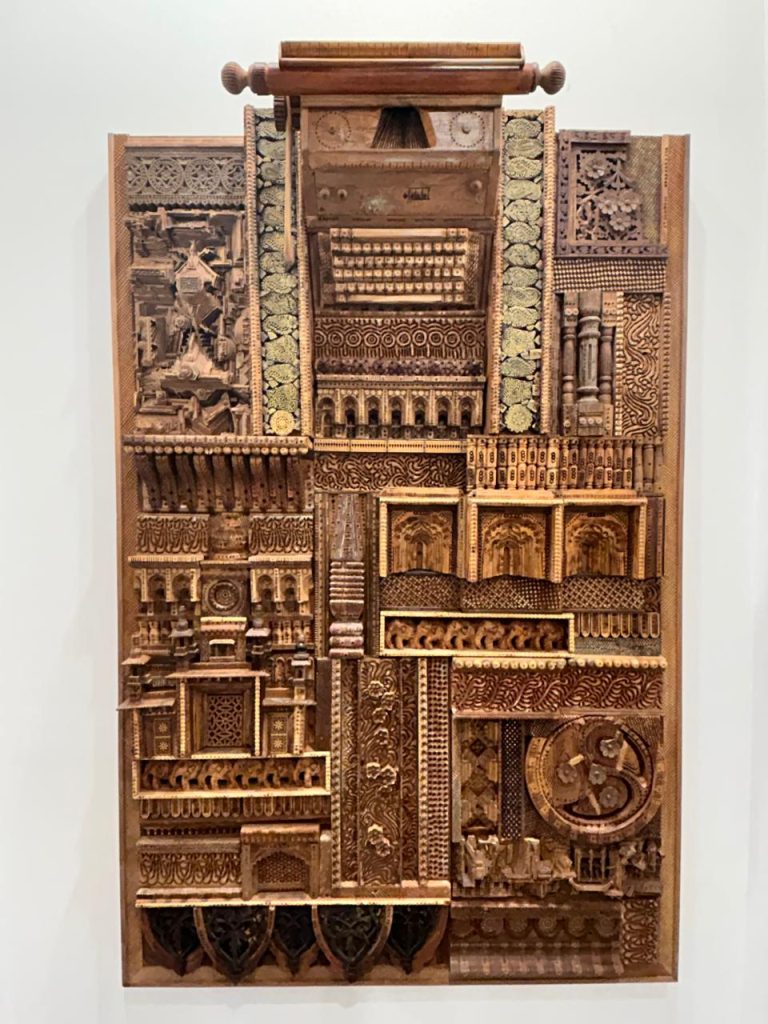
The work ‘The Karma’ made in teak wood is a meticulous reflection of ancient Indian architecture. At the same time, by naming it ‘Karma’, the artwork is elevated to another level. The artwork ‘Village Market’, made in marble, as well as ‘Village Banana’ and ‘Village Drink’, made in wood and metal, are highly realistic and evoke the essence of village life.
Promiti Hossain: Fragmented and Abstracted
Promiti Hossain is a Bangladeshi practising artist with a background of mixed nationalities and religious descent. Promiti Iram Art presents Promiti’s artworks inspired by Bengali literature and personal narratives, using metaphors and symbols to tell her stories. Promiti’s creations are remarkable both in terms of the people and their landscapes, as well as in the efforts to reclaim what has been lost and where.
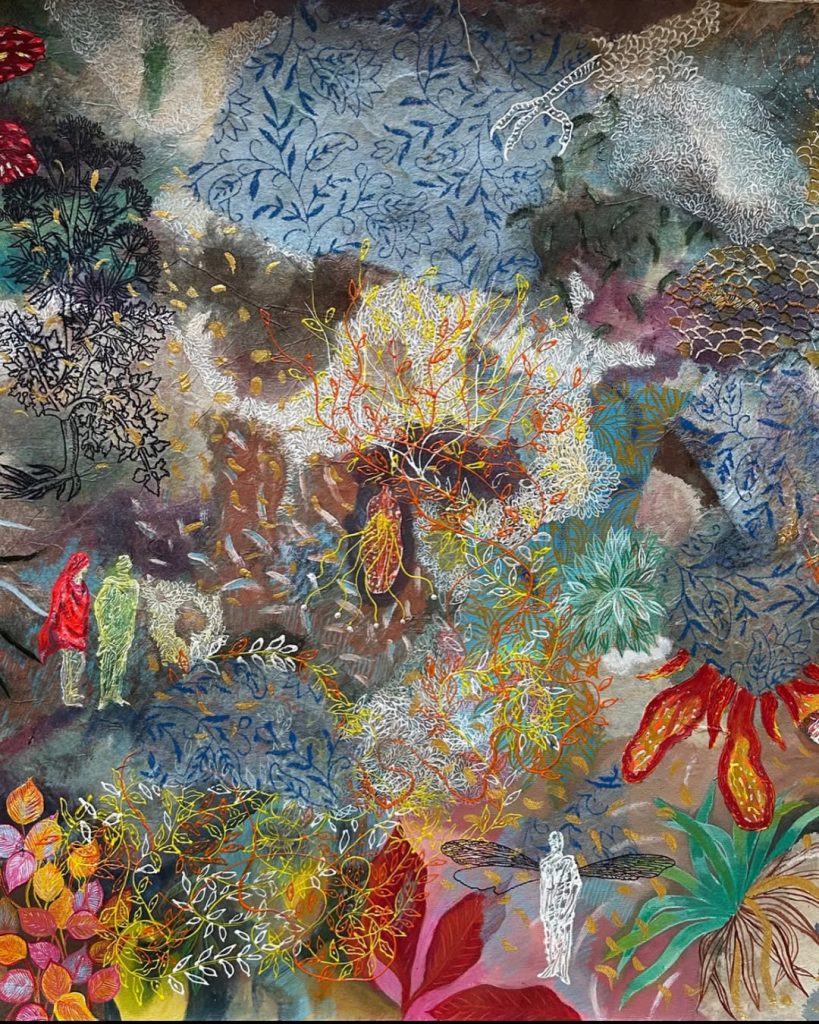
The artist’s composition and canvas, who has lived in many different places, stand apart because of the belief that people are only abstract objects in the landscape. The words of life are portrayed here as brittle, lost, or reclaimed—what might be called an abstraction—amid paddy fields, trees, flowers, mountains, and birds. In compositions where colours flow, it is the viewer’s actual task to capture the subtle things the artist conveys, without getting lost in themselves. When light falls on the canvas, some hidden shadows and signs that the artist has concealed reappear.
Sandilya Theuerkauf: Ecological being
Sandilya Theuerkauf’s art practice and ideas, showcased at Kynkyny Art Gallery, are inextricably linked to his formative years in Kerala, spent surrounded by nature, as well as to his work as a restoration ecologist and environmental educator. Works displayed at the fair use the bark of a tree, each piece fixed perpendicular to the other. Those works tell that his goals for his artistic endeavours are still rooted in a personal story of education and communication. In both their material composition and visual form, Sandilya’s sculpture-reliefs are profoundly rooted in the experience of nature. His art is fueled by his wilderness excursions and his conscious attention to all the animate and inanimate elements of the area he finds himself in.
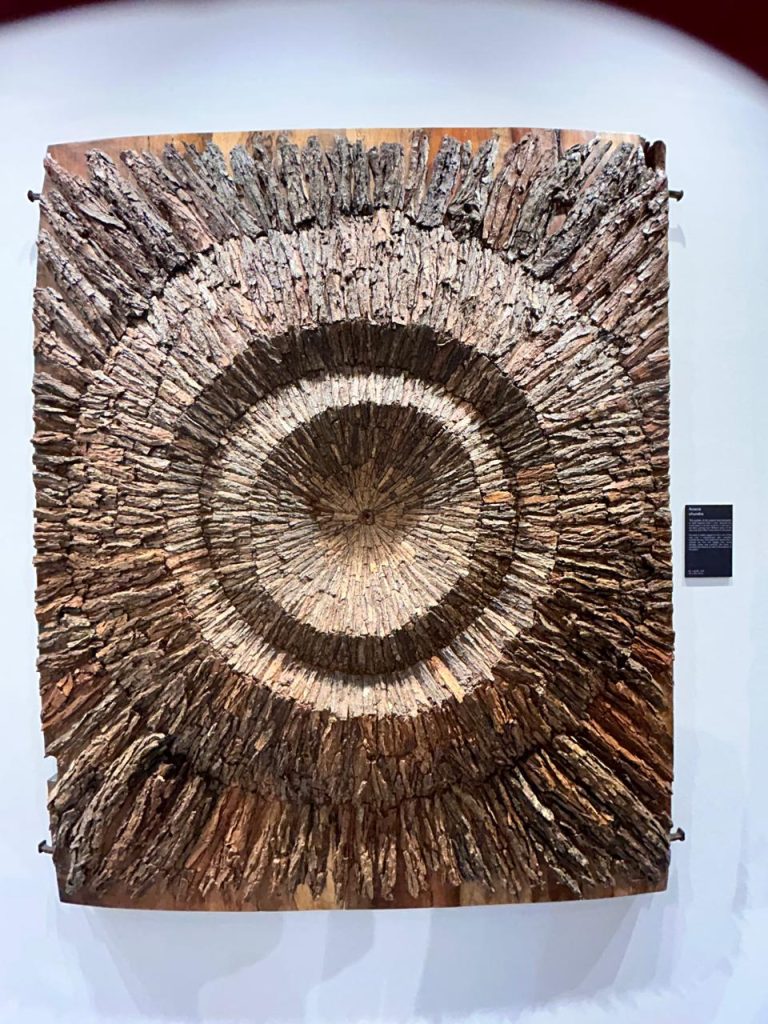
We can see that he rejects deliberate search and planned results in favour of intuitive reactions to his environment when obtaining raw materials. His earthy, handcrafted expressions have become open to interpretation and meaning in various contexts over the years, and working with his hands is essential to translating these multi-layered experiences.

Contributor